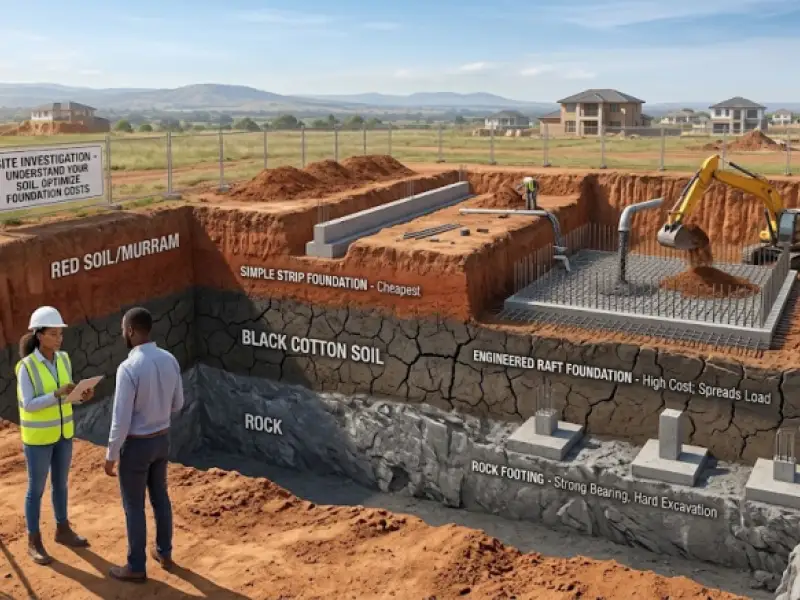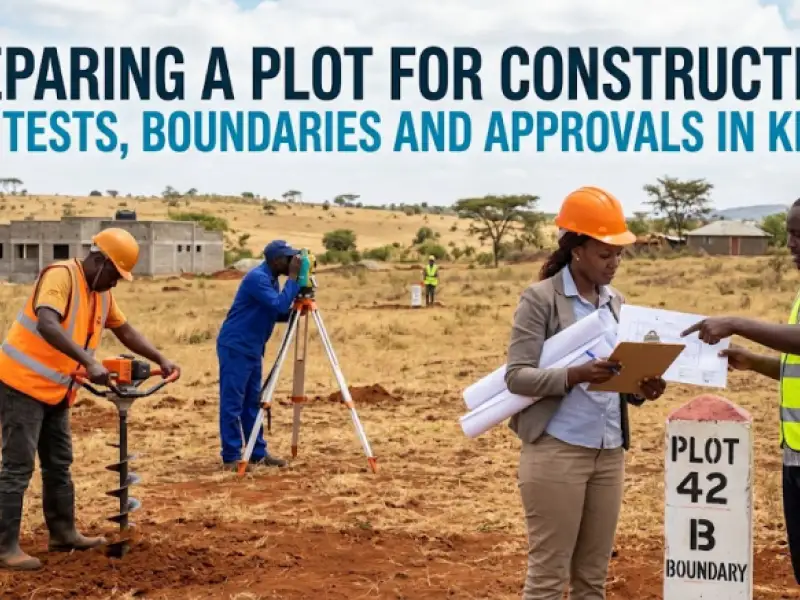

A stand-alone construction loan Kenya is a short-term facility that funds your build in stages and does not automatically convert to a long-term mortgage. You close twice (one loan for construction, a second for the permanent mortgage), so you carry more rate-change risk and duplicated fees—but you also get flexibility to shop for the best take-out mortgage after completion. Banks in Kenya typically disburse in tranches against approved plans + QS BoQ, charge interest-only during construction, then require you to refinance at completion.
Why this matters in 2025
- Mortgage market size: Kenya had 30,016 residential mortgage accounts outstanding totaling KES 279.27B as at December 2024 (average mortgage size ≈ KES 9.3M). That’s still tiny relative to demand, so self-builds financed via construction facilities remain common.
- Rate backdrop: The Central Bank Rate (CBR) is 9.50% (as of Aug 12, 2025), and banks price construction loans off their internal base/prime above CBR. Your eventual refinance rate can move during the build—key risk with a stand-alone construction loan Kenya.
What is a stand-alone construction loan?
A stand-alone construction loan is short-term, interest-only finance that funds your build in stages (foundation, walling, roofing, finishes, etc.). At completion you must take a separate, long-term mortgage to pay it off—hence two closings and two sets of fees. (This differs from a “construction-to-permanent” loan that automatically converts.)
Read Also: Construction Mortgage Kenya: What It Is, How It Works, and How to Apply
See what is available now.View homes
How Kenyan banks typically structure Stand-alone vs. Construction-to-Permanent (CTP)
(General framework; confirm exact terms with your lender. Kenyan pages shown above illustrate local practices.)
Read Also: A Rock in the Construction Industry. A Name You Can Trust – WILLSTONE HOMES
Costs & mandatory charges to budget for in Kenya

- Bank fees: arrangement/processing, valuation (initial + each stage), legal fees; many bank fees attract excise duty on financial services (commonly 20% on “other fees”).
- Taxes & government charges:
- Stamp duty on charge/mortgage: typically 0.1% of the secured amount (urban).
- VAT: professional services (architect, QS, engineer, valuer, legal) generally 16%.
- Approvals & permits: county plan approval fees and inspection fees (vary by county); EIA licence/fees where NEMA requires an Environmental Impact Assessment.
- NCA: The NCA levy framework exists in law, though the 0.5% construction levy has seen policy changes/suspensions; check current status at application time.
Worked example (numbers for illustration)
Scenario: Build cost KES 12M on land you own. You borrow KES 9M via a stand-alone construction loan Kenya, disbursed in four tranches over 8 months: 20% (month 2), 30% (month 4), 30% (month 6), 20% (month 8). Construction interest rate: 16% p.a., interest-only on amounts drawn.
- Total interest during build ≈ KES 480,000 (aggregate of monthly interest on each tranche until month 8).
- At completion you must refinance the KES 9M into a permanent mortgage (say 18-year term):
- If rates available are 12%, payment ≈ KES 101,876/month.
- If rates are 15%, payment ≈ KES 120,752/month.
- If rates jump to 18%, payment ≈ KES 140,642/month.
That’s a KES ~18,900/month swing between 12% and 15%—the core risk of going stand-alone. (Illustrative only; each bank’s pricing, fees, and amortisation differ.)
Why some borrowers still choose stand-alone: You can shop the market post-completion, including KMRC-backed fixed-rate mortgages (some lenders advertise 9.5% p.a. fixed for qualifying affordable homes).
Eligibility & documents (typical Kenyan checklist)
- Land & title: Clean title deed/lease, official search, beacon certificate where applicable.
- Plans & approvals: County-approved architectural and structural drawings; permits; EIA licence if required.
- BoQ & professionals: BoQ by a registered QS, architect/engineer practicing certificates; sometimes a fixed-price contract with the contractor.
- Insurance: Builder’s/Contractor’s All-Risk during construction; fire/house insurance post-completion (lender-assigned interest noted).
- Income & KRA: Payslips/bank statements (usually 6–12 months), KRA PIN, employment letter or audited accounts (self-employed).
- Valuations: Bank panel valuer for initial and stage valuations; fees apply.
Step-by-step: How to apply (and actually get funded)
- Decide product fit
Ask lenders plainly: “Is this a stand-alone construction facility that requires a separate mortgage at completion?”
Compare with CTP offers (one-closing) to quantify fee and rate-risk trade-offs. - Get pre-assessment
Lender checks affordability and the project’s viability against CBR-linked pricing and internal prime. Expect conditional approval subject to documents and valuation. - Submit your pack
Title + searches, approved plans, QS BoQ, contractor contract, IDs/KRA, income proofs, insurance notes. Absa/Stanbic/KCB detail these elements on their product pages. - Legal & security perfection
Bank’s lawyer prepares the charge over land; you pay legal fees, 0.1% stamp duty on the charge, and registration costs. - First drawdown
After conditions precedent, lender releases the first tranche. You pay interest-only on amounts drawn. Further tranches follow stage valuation sign-offs. - Practical completion
Provide completion certificate/occupation permit where applicable. With a stand-alone construction loan Kenya, you now apply for (or shift to) the permanent mortgage (second closing). If eligible, consider KMRC-backed fixed-rate offers. - Refinance risks to manage
- Rate-lock gap: CBR or bank prime could move before you close the mortgage.
- Cost overruns: keep a 10–15% contingency outside the loan to avoid funding gaps.
- Revaluation timing: each tranche needs a valuer visit; budget time and fees.
Pros & cons (Kenyan lens)
Advantages
- Freedom to shop the best mortgage at completion (including fixed-rate KMRC windows).
- Can match niche build timelines/contractor schedules better than some CTP products.
- Potential savings if market rates fall during your build.
Trade-offs
- Two sets of fees (legal, valuation, processing, some with excise duty).
- Rate-change risk till you refinance.
- More paperwork and coordination versus one-closing CTP options.
Smart ways to de-risk your stand-alone build
- Ask for a written take-out plan (even a conditional mortgage offer) timed to completion.
- Stage calendar: Agree the disbursement calendar with your QS and bank upfront to avoid idle contractor time.
- Insurance: Ensure Contractor’s-All-Risk during the build; switch to homeowners/fire on handover.
- Tax & fees line-item: Add VAT (16%) on professional services and the 0.1% charge stamp duty into your budget from day one.
- Compare with CTP: If you value certainty, a construction-to-permanent loan (e.g., Stanbic’s 1-year build + 240 months) may beat a stand-alone construction loan Kenya despite slightly higher headline rates.
Read Also: Harambee Stars Inspire Kenyans—And Willstone Homes Shows How Dreams Are Built
A stand-alone construction loan Kenya gives you flexibility and bargaining power at completion—but you’ll shoulder duplicated fees and the risk that long-term rates are worse when your house is ready. If you want simplicity and rate certainty, compare CTP offers side-by-side. Either way, anchor your plan to today’s CBR (9.50%), budget for taxes/fees, and lock in your QS-driven draw schedule before you break ground.
Contact Us
- Park Suites, 44 Parklands Road, Ground Floor, Suite 1, Willstone Homes
- +254711082011
- [email protected]
Key sources
- CBK Banking Supervision Annual Report 2024: mortgage stock & accounts; average size. Central Bank of Kenya
- CBK MPC: Central Bank Rate 9.50% (Aug 12, 2025). LinkedIn
- Absa Kenya construction loan features (interest-only, 9-month moratorium, stage valuations). Absa
- Stanbic Kenya construction financing (1-year build + up to 240-month term). Stanbic Bank
- KCB construction mortgage explainer (up to 90% of project cost; staged disbursements). KCB Bank Kenya
- Standard Chartered Kenya construction mortgage (limits up to KES 100M). Standard Chartered Bank
- Stamp duty on charge (Ministry of Lands). PwC
- VAT rate 16% (KRA). Kenya Revenue Authority
- Excise duty on bank fees (indicative 20% via court reference).