
Finding a viable rental property requires looking past promotional gloss and analyzing cold, hard numbers. While no single rule dictates real estate success, using 7% gross yield as a target screening benchmark allows you to quickly evaluate whether a residential deal deserves a deeper financial audit.
Data from Cytonn places the Nairobi Metropolitan Area (NMA) overall residential rental yield at 5.9%, with detached single-family homes averaging 5.3%. However, data from the Kenya National Bureau of Statistics (KNBS) reveals that specific typologies—such as three-bedroom maisonettes (8.0%) and two-bedroom townhouses (8.3%)—can hit or exceed the 7% threshold.
To evaluate opportunities effectively, smart investors apply a 3-stage property screening framework.
See what is available now.View homes
Stage 1: The 7% Gross Yield & Valuation Filter
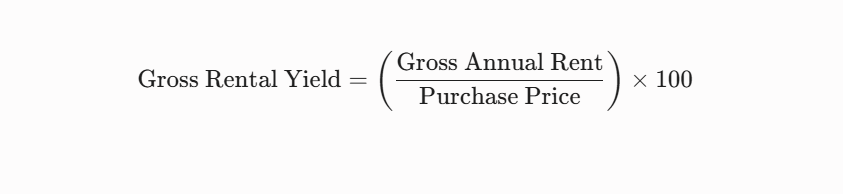
Gross yield measures a property’s annual rental income against its purchase price before operational expenses:
The Reverse Calculation: Your Negotiation Tool
Instead of waiting to see what yield a property produces, flip the formula to determine the maximum price you should pay based on current neighborhood rental rates:
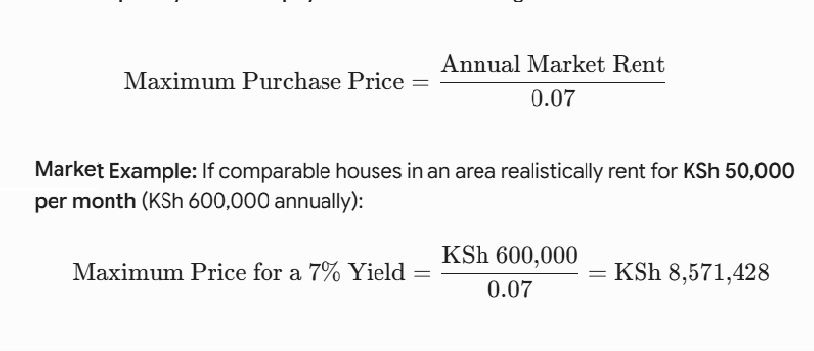
If a seller demands KSh 10,000,000 for that same home, the gross yield drops to 6.0% ($\text{KSh 600,000} \div \text{KSh 10,000,000}$). This immediately signals that you must either negotiate the price down or accept a lower initial cash return in exchange for other benefits like land growth.
Read Also: Surging Land Prices in Ruiru & Thika: Why Savvy Buyers Are Turning to Gated Community Homes
Stage 2: The Net Yield Reality Check
A property that passes the 7% gross benchmark will not put a full 7% into your bank account. Operating expenses eat into gross revenue. To find your Net Yield, deduct annual ownership costs:
On an KSh 8.57M purchase, a 7.0% gross yield converts to a realistic ~4.9% net yield. Factoring in these holding costs ensures you build an accurate cash-flow projection.
Stage 3: Total Return (Yield + Capital Appreciation)
Rental yield is only half of the real estate wealth equation:

A detached home in a mature urban neighborhood might yield a modest 5.2% gross, but sits on land appreciating at 8%–10% per year. Conversely, a high-density unit might offer an 8% gross yield in an overbuilt pocket with stagnant property values.
Never use hypothetical appreciation to justify a severe monthly loss, but weigh both metrics when choosing between high-yield entry units and high-growth land corridors.
Read Also: What the Landmark KRA Service Charge Ruling Means for Kenyan Homeowners
Evaluating Yield Potential with Willstone Homes
Achieving competitive rental yields requires investing in property layouts and locations that appeal directly to long-term tenants.
Willstone Homes develops master-planned, gated communities—such as Mang’u Grove Seattle Bungalows and projects across the expanding Kiambu County transport corridors. By focusing on high-demand features—including perimeter security, paved estate roads, reliable water connection, and dedicated family amenities—these gated residential environments are designed to minimize vacancy risks and support sustainable tenant retention.
Ready to evaluate investment-ready homes across Nairobi and Kiambu?
Explore Willstone Homes’ project portfolio to review site layouts, pricing structures, and locations engineered for long-term growth.