

If you have spent any time browsing real estate listings across Nairobi, Kiambu, Machakos, or the coastal strip, you have likely encountered a frustrating phenomenon: two nearly identical houses in the same neighborhood with price tags that are millions of Shillings apart.
In Kenya’s vibrant real estate landscape, asking prices rarely tell the whole story. Many sellers price their property based on emotional attachment, speculative hype, or the price their neighbor claims to have sold for over evening drinks. As a serious buyer, navigating this market requires separating grounded market pricing from wishful thinking.
Here is how to analyze property pricing in Kenya to ensure you pay fair market value and avoid overpaying for someone else’s dream.
1. Real Prices vs. Wishful Thinking: At a Glance
Before diving into complex checks, evaluating a property’s market position across five core indicators offers immediate clarity:
| Marker | Priced for Real Buyers | Wishful Thinking / Overpriced |
| Time on Market | Under 90–120 days with steady viewings | Listed for 6–12+ months with zero movement |
| Gross Rental Yield | 6% – 8.5% annually | Below 4.5% annually |
| Bank Valuation Alignment | Matches or exceeds asking price | Bank appraisal falls 15%–30% short |
| Seller Motivation | Clear timeline (relocating, liquidating, reinvesting) | “I’m in no rush; I’ll wait for the right buyer” |
| Price Flexibility | Open to reasonable negotiation (5%–10%) | Rigid price with high-pressure tactics |
2. The Four Tests of Property Valuation
To determine whether a seller is realistic, put the property through these four practical tests before signing a offer letter or placing a deposit.
Test 1: The Rental Yield Benchmark
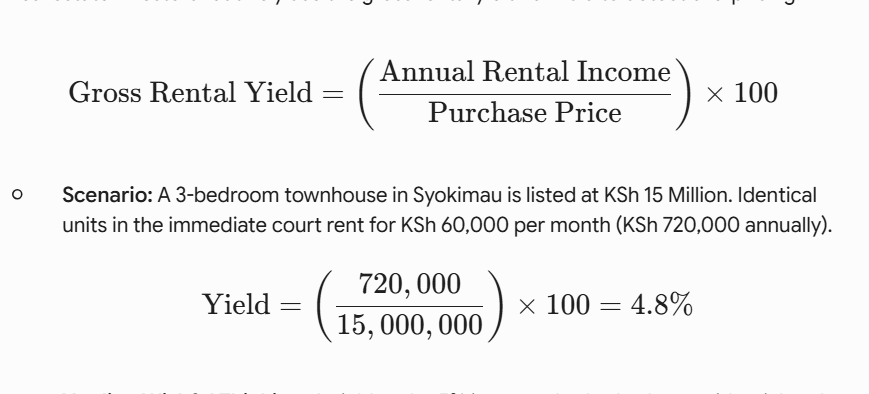
Income-generating potential is one of the most reliable anchors for residential valuation. Real estate investors routinely use the gross rental yield formula to detect overpricing:
- Scenario: A 3-bedroom townhouse in Syokimau is listed at KSh 15 Million. Identical units in the immediate court rent for KSh 60,000 per month (KSh 720,000 annually).$$\text{Yield} = \left(\frac{720,000}{15,000,000}\right) \times 100 = 4.8\%$$
- Verdict: Wishful Thinking. A yield under 5% in a standard suburban residential node indicates the price is driven by future speculative hopes rather than current income realities. Healthy residential yields in Kenya generally hover between 6% and 8%.
Test 2: The Independent Bank Valuation Check
Listing portals display what sellers hope to get; bank valuations reveal what the market actually supports. Bank-appointed registered valuers evaluate properties using verified comparative sales data.
- If a home is advertised at KSh 22 Million, but two independent financial institutions value it at KSh 17 Million, the asking price reflects fantasy rather than value.
- Smart Buyer Strategy: Even if purchasing with cash, retain a registered valuer (VRB-registered) for a nominal fee (typically KSh 15,000 to KSh 30,000) to conduct a professional valuation before making a binding offer.
Test 3: Closing Data vs. Online Listings
Relying solely on property listing websites can skew market perception, as those prices represent asking rates, not finalized conveyancing figures.
To uncover actual transaction prices:
- Consult local conveyancing advocates or Estate Agents Registration Board (EARB) registered agents operating in that specific estate.
- Inquire about the exact transaction figures for recent comparable sales on that street over the past six months.
Test 4: The Total Cost of Acquisition
A house priced at “market rate” can quickly become overpriced if it carries hidden liabilities or structural defects. Factor in the total cost of ownership:
- Statutory Acquisition Costs: Remember that purchasing property in Kenya incurs an additional 7% to 11% in transactional overhead (Stamp Duty at 2%–4%, legal fees at 1%–2% + VAT, valuation fees, and registration costs).
- Outstanding Rates & Rent: Verify that county land rates and national land rent are fully paid up with clearance certificates available.
- Repairs & Snagging: A house listed at KSh 12 Million that requires KSh 2.5 Million in structural repairs or utility connections is effectively a KSh 14.5 Million purchase.
3. Red Flags to Watch Out For
- The “Prestige Markup”: Sellers demanding premium prices solely due to a high-profile neighborhood name (e.g., Kileleshwa, Runda, or Karen), despite poor access infrastructure, severe traffic choke points, or outdated interiors.
- Artificial Urgency: Agents or sellers claiming, “I have two cash buyers making offers today, pay a deposit now,” to bypass proper due diligence.
- Unapproved Additions: Sellers inflating prices based on extra units or extensions that lack requisite county government or NEMA approvals, posing future legal and demolition risks.
Conclusion: Making Your Move
Distinguishing between a realistic seller and a speculative one saves time, money, and frustration. When you spot a property that fails the market checks, you don’t necessarily have to walk away immediately. Instead, present a data-backed written offer supported by independent valuation reports and local rental yields.
A serious seller facing market realities will engage with a well-researched, funded offer. A seller holding out for wishful figures will refuse to budge—and in those cases, the smartest move is to let the property sit on the market until reality brings the price back down to earth.