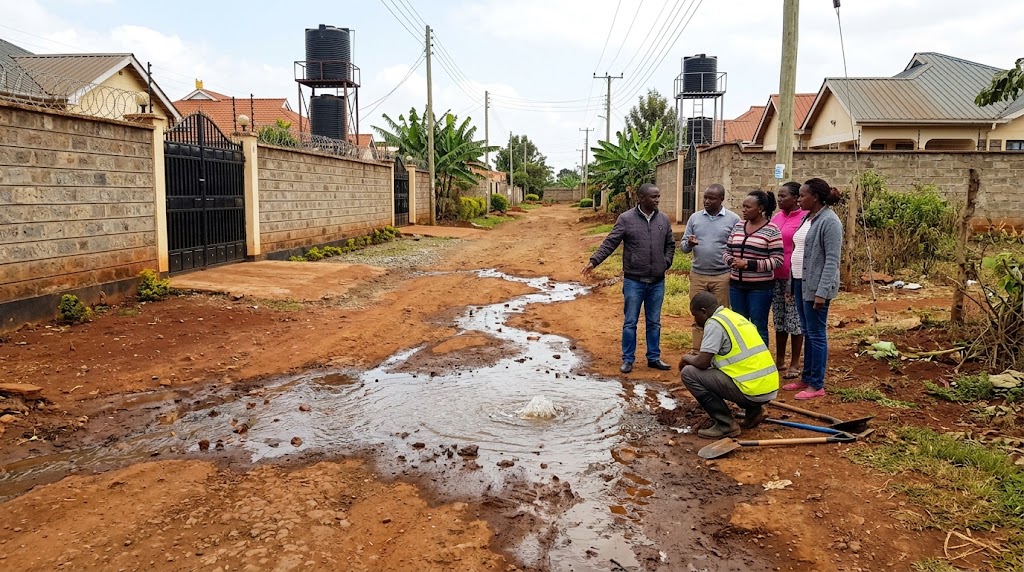
It usually starts the same way: water is pooling on the access road that three or four plots share. Nobody’s tap has pressure. And every household is looking at the next, waiting for someone to admit it’s their problem and pay for the fix.
Shared access roads are standard across Kenya, especially where larger land parcels were subdivided into individual plots sharing a single entry corridor. Water lines are almost always laid under or alongside these roads to reach each property.
When a pipe fails, who pays depends on one crucial distinction: is the pipe a public utility asset or private infrastructure?
The 3 Types of Water Pipes Under Shared Access Roads
Kenyan law treats water pipes differently depending on where they sit relative to the supply network and meter point:
[WSP Water Main] ---> (WSP Meter Point) ---> [Shared Private Line] ---> [Individual Plot Pipe]
  (WSP Pays)                                     (Owners Share)            (Single Owner Pays)
| Pipe Classification | Primary Responsibility | Legal & Statutory Basis |
| 1. WSP Water Main | Water Service Provider (WSP) | Water Act 2016 & WASREB Regulations |
| 2. Shared Connector Pipe | Joint Plot Owners | Private property & shared easement principles |
| 3. Individual Branch Line | Single Plot Owner | Customer-side infrastructure responsibility |
1. A Water Main Belonging to the Water Service Provider (WSP)
Every county has a licensed Water Service Provider (such as Nairobi Water, RUJWASCO, or ELDOWAS) responsible for supplying water and maintaining the distribution network.
Under the Water Act 2016 and standards set by the Water Services Regulatory Board (WASREB), the WSP must repair leaks and burst mains on its network to restore service to affected consumers. If the burst pipe is a primary main serving multiple properties beyond your immediate gate, it is a WSP asset. The WSP pays for the repair.
Read Also: How Land Outside Nairobi Beat Every Other Investment Over the Last 18 Years
2. A Shared Connector Pipe Serving Your Group of Plots
This is where 90% of neighbour disputes happen. A branch pipe splits off from the main line and runs under your private access road to feed a specific cluster of plots.
This line is almost never owned or maintained by the WSP—it was laid by the original land developer or by the plot owners themselves. Responsibility for this line falls jointly on the households it serves, in the same way owners jointly maintain the road surface itself.
3. An Individual Service Pipe Crossing Shared Land
If a pipe exists solely to serve your plot but runs under the shared road to reach your boundary, you are solely responsible for maintaining it. If repairing your pipe requires excavating the shared access road, you also owe your neighbours a duty to fully restore the road surface afterward.
Why the Wayleaves Act (Cap 292) Matters Here

Under the Wayleaves Act (Cap 292), government authorities and public utilities have statutory powers to carry water mains, sewers, and drains through private land after giving proper notice to landowners.
- Registered Wayleave: If your access road deed plan has a registered wayleave or public easement in favor of the WSP, the utility maintains access rights and service obligations over that line.
- Unregistered / Private Line: If there is no formal wayleave and the line was laid privately, the WSP’s legal boundary stops at the master meter or point of connection. Everything downstream is private infrastructure.
What Decides Who Pays? (In Order of Importance)
- The WSP Connection Point: Ask your local water company where their network ends. WSPs operate up to the meter; anything after the meter point belongs to the consumer(s).
- Wayleave or Easement Status: A registered easement on the title plan clarifies whether the line is part of the public utility network.
- Number of Benefiting Plots: Damage on a main connector feeding four plots is divided four ways. Damage on a single branch feeding Plot B is borne 100% by Plot B.
- Cause of the Burst: Normal wear and tear or aging pipes are split among served owners. However, if a contractor or neighbour damages the pipe while excavating or driving heavy machinery, the party who caused the damage is liable for repair costs.
What to Check Before Buying a Subdivided Plot
When inspecting land or an unmanaged property on a shared access road, add water infrastructure to your due diligence checklist:
- Identify the Connection: Is it an individual direct WSP meter line or a shared private line from a cluster connection?
- Check for a Maintenance Agreement: Ask if existing owners have a written or informal agreement covering shared road and utility maintenance.
- Inspect Title Deed Plans: Look for registered wayleaves for water or sewer lines.
- Inspect Pipe Material: Modern High-Density Polyethylene (HDPE) lines handle ground movement better than older galvanized iron or low-grade PVC pipes.
Read Also: Who Owns the Road to Your Plot? Access Roads, Wayleaves, and Landlocked Parcels
What to Do If a Pipe Bursts Under Your Road Today
- Call Your WSP First: Report the leak immediately to determine if the burst is on the WSP main line.
- Hold a Meeting with Affected Neighbours: If it is a shared private line, agree on a contractor and cost-split before work begins. Splitting costs equally per benefiting plot is standard practice.
- Document the Damage: Take photographs of the burst, the excavation, and the road condition before and after repairs.
- Formalize Future Maintenance: Use the event to create a simple signed agreement among plot owners for future utility maintenance.
The Willstone Homes Advantage: Stress-Free Utility Infrastructure

When you buy a home in a Willstone Homes gated community (such as Mang’u Grove, Manna Residence, Windsor Ridge, or White Park Estates), you never have to worry about unmapped pipes or utility arguments with neighbours.
Willstone Homes builds master-planned gated communities engineered with hassle-free infrastructure built-in:
- Dedicated Estate Water Systems: Our developments feature high-capacity estate boreholes paired with overhead storage systems, ensuring uninterrupted water pressure without relying solely on municipal mains.
- Pre-Engineered Cabro Roads & Utility Corridors: Service lines and drainage are laid within dedicated utility trenches beneath high-quality cabro driveways prior to paving, preventing messy road cuts or structural damage during routine maintenance.
- Professional Estate Management: Every Willstone estate operates under a clear covenant. Common infrastructure—including internal access roads, perimeter security, and shared water trunk lines—is managed centrally through an estate management framework so individual homeowners never deal with door-to-door repair bills.
Read Also: Budget-Friendly Finishes That Add Resale Value in Kenya
Looking for a Modern Bungalow or Maisonette in a Managed Gated Community?
Skip the headaches of unmanaged access roads and informal subdivisions.Book a free site visit with Willstone Homes today to view our completed and ongoing projects across Ruiru, Juja, Kenyatta Road, and Kangundo Road.
Call/WhatsApp: +254 711 082 011 | Website:willstonehomes.ke
Frequently Asked Questions
Who is responsible for a burst water main in Kenya?
The county-licensed Water Service Provider (WSP) is legally responsible for repairing public water mains and distribution lines up to the customer meter point.
Who pays for a burst pipe under a shared access road?
If the burst pipe is located after the main WSP meter and serves multiple private plots, repair costs are shared jointly by the plot owners connected to that line.
What if a pipe serves only my plot but runs under a shared road?
You are individually responsible for repairing private supply lines that serve only your plot, and you must restore any shared road surface damaged during repairs.
Can I force my neighbours to pay for a shared pipe repair?
Jointly used private infrastructure carries shared responsibility under general property principles. If a neighbour refuses to contribute, disputes can be resolved through local leadership, mediation, or the Small Claims Court.
How do I find out where the WSP responsibility ends?
Contact your local Water Service Provider (e.g., Nairobi Water, RUJWASCO) directly and request verification of your property’s official connection point or meter boundary.
Learn more about Willstone Homes gated community design and infrastructure: WILLSTONE HOMES – ALONG KENYATTA ROAD. This video gives a visual walkthrough of Willstone Homes developments, showcasing estate infrastructure, road layouts, and amenities along Kenyatta Road.
DISCLAIMER: This article is general information based on Kenyan water and land law, not legal advice. For a specific dispute, consult an advocate and your local Water Service Provider.