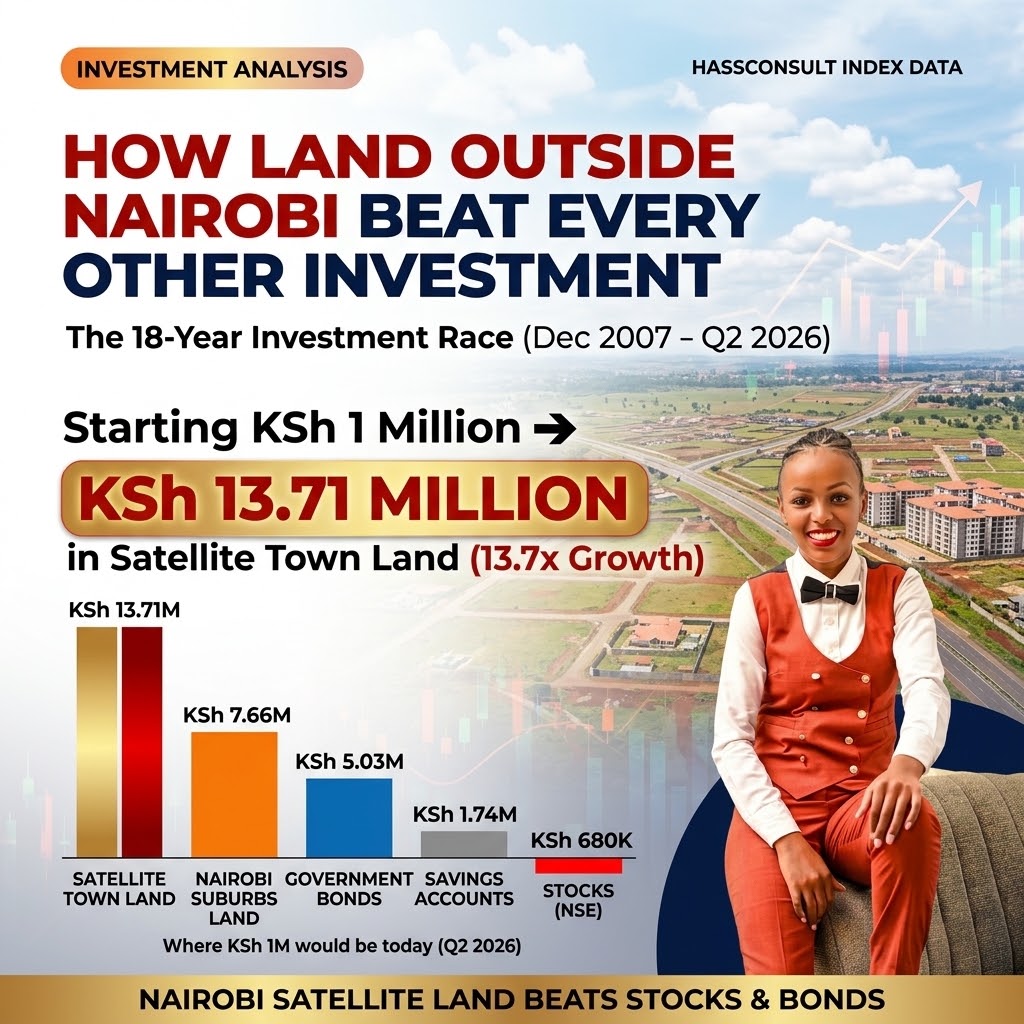
If you handed six investors KSh 1 million each in December 2007 and instructed them to hold different asset classes until mid-2026, the contrast in their fortunes today would be staggering.
The investor who purchased equities on the Nairobi Securities Exchange (NSE) would be holding a bruised portfolio worth KSh 680,000—a net capital loss over nearly two decades. Meanwhile, the investor who parked their capital in fixed-income government bonds would have grown their wealth to KSh 5.03 million.
The ultimate victor of this 18-year marathon sits on the periphery of the capital city. An initial KSh 1 million invested in land across Nairobi’s satellite towns exploded to KSh 13.71 million by the second quarter of 2026, easily outpacing every conventional investment vehicle in Kenya.
Read Also: Kenya Changed Its Building Rules. Why Are Alternative Homes Still So Hard to Finance?
18-Year Asset Class Scorecard (2007 – 2026)
Tracking the trajectory of KSh 1,000,000 invested in December 2007 through Q2 2026 illustrates how Nairobi’s urban expansion fundamentally reshaped wealth creation in East Africa.
| Investment Vehicle | Q2 2026 Portfolio Value | Total Return / Multiplier | Market Trajectory |
| Satellite Town Land | KSh 13,710,000 | 13.71x | Rapid suburbanization, commuter demand |
| Nairobi Suburbs Land | KSh 7,660,000 | 7.66x | Established luxury preservation |
| Bonds (Fixed Income) | KSh 5,030,000 | 5.03x | Stable yield compounding |
| Hass Residential Index | KSh 2,920,000 | 2.92x | Moderate residential real estate growth |
| Savings Accounts | KSh 1,740,000 | 1.74x | Capital erosion via inflation |
| Equities (NSE) | KSh 680,000 | 0.68x (-32%) | Prolonged equity market stagnation |
The Engine Behind the Fringe: Infrastructure & Policy Clarity
The staggering 13.7-fold growth in satellite town land is not an indiscriminate tide lifting all boats. According to data from the HassConsult Land Price Index, the market has transitioned into a highly selective recovery phase. Growth is tightly cluster-bound, gravitating toward regions anchored by major transport corridors, commercial nodes, and emerging employment hubs.
“The recovery across Nairobi’s satellite towns is becoming increasingly selective. Growth is concentrating in locations with strong economic and infrastructure drivers… that create sustained demand for development,” notes Sakina Hassanali, Co-CEO and Creative Director at HassConsult.
Beyond infrastructure, regulatory policy has reignited developer confidence. The publication of the updated Nairobi County Property Development Policy provided much-needed clarity on building approvals, unlocking stalled projects and spurring fresh demand for development land. Consequently, both established suburbs and satellite towns posted a 1.4% quarterly price expansion in Q2 2026, rebounding sharply from 0.8% and 0.5% in Q1, respectively.
Read Also: Before You Say “It’s Too Far”: What Umoja and Kayole Can Teach Today’s Property Buyers
A Tale of Two Outer Rings: Winners vs. Laggards
The market’s selectivity is evident in the divergence among satellite towns. Out of the 14 satellite locations tracked by HassConsult, seven recorded price contraction during Q2 2026, while industrial and commuter hubs posted gains:
The Top Growth Nodes
- Ruiru: Surged 4.1% quarter-on-quarter to reach an average of KSh 42.2 million per acre, propelled by industrial park development and superhighway access.
- Thika: Rose 3.8% to KSh 32.4 million per acre, benefiting from industrial expansion and affordable housing density.
- Ruaka: Expanded 2.8% to hit KSh 115.7 million per acre, cementing its position as a high-density, multi-family residential magnet near diplomatic zones.
The Declining Nodes
- Ngong: Led losses with a 2.5% quarterly drop, pointing to temporary overvaluation and slowing buyer momentum.
- Limuru: Retracted by 0.8%, reflecting quieter commercial activity relative to Eastern and Northern bypass corridors.
Inner Suburbs Pivot: The Rise of Lang’ata and Karen
Within Nairobi’s traditional city boundaries, capital is shifting toward green, spacious suburbs offering lower entry thresholds relative to ultra-prime urban blocks.
- Lang’ata: Led all inner suburbs with 4.1% quarterly growth, lifting land values to KSh 94.7 million per acre.
- Karen: Posted a 3.2% gain to hit KSh 79.5 million per acre—marking its strongest single-quarter growth in a decade.
- Runda & Nyari: Gained 2.9% (KSh 105.6 million/acre) and 2.5% (KSh 128.2 million/acre) respectively.
As Hassanali explains, homebuilders and private buyers building detached and semi-detached residences are deliberately bypassing saturated city cores to secure larger plots at accessible acquisition costs in nodes like Karen and Lang’ata.
Strategic Takeaway for Investors
The 18-year data confirms that while land on Nairobi’s perimeter remains Kenya’s premier wealth builder, the era of speculative, buy-anything land investment is over. Future outperformance will depend strictly on micro-location fundamentals: proximity to dual-carriageway infrastructure, updated zoning laws, and direct connection to commercial hubs.
Read Also: The DSQ Question: How Should a Modern Home Balance Family Privacy and Domestic Support?
Looking to build wealth in Nairobi’s top-performing satellite town?
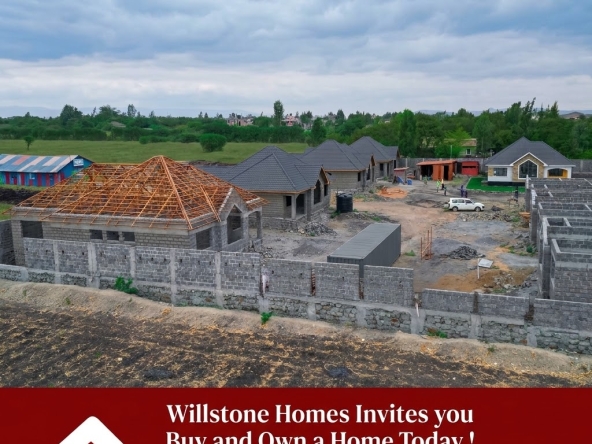
Don’t let your capital sit idle. Willstone Homes offers modern, title-deed-ready maisonettes along the high-growth Thika Road & Ruiru axis—giving you direct exposure to the exact market driving Kenya’s best property returns.
👉 Talk to Willstone Homes today at 0711 082 011 or visit willstonehomes.ke to secure your property.