

For many diaspora investors considering real estate in Nairobi Kenya, the usual due-diligence checklist focuses on title verification, developer reputation, and pricing. However, a new layer of risk has emerged that is not always visible on paper: local political and community dynamics. Understanding how local leadership transitions, land activism and informal settlement expansion influence property performance is now essential for anyone buying from abroad.
This qualitative risk layer can directly affect ownership security, project timelines, tenant demand, and even resale value — making it a top concern for diaspora property investment in Nairobi Kenya that smart investors cannot ignore.
Read Also: The New Hidden Cost of High-Rise Living in Nairobi: Vertical Service Dependency
The political landscape and land governance: what investors often miss

Kenya’s land governance context is deeply intertwined with politics, history and local mobilisation. Much of this complexity plays out at the county and neighbourhood level, where decisions about zoning, infrastructure and enforcement are shaped by elected leaders and community interests — often with little transparency for absentee buyers.
When local leadership priorities shift — for example due to elections, county budget changes or emerging interest groups — property prospects can change too. Investors who purchased land because it was on a planned road alignment or adjacent to a major upgrade may find those priorities altered when new officials take office.
This is rooted in Kenya’s broader urbanisation patterns, where land has historically been a source of political negotiation and wealth accumulation. Elite networks often move early on anticipated infrastructure investments, which can leave later investors exposed to political shifts that are not easy to anticipate from abroad.
Read Also: Why Mixed-Use Projects in Nairobi Are Underperforming — and How Developers Can Fix It
Informal settlements and land contestation: not just a social issue
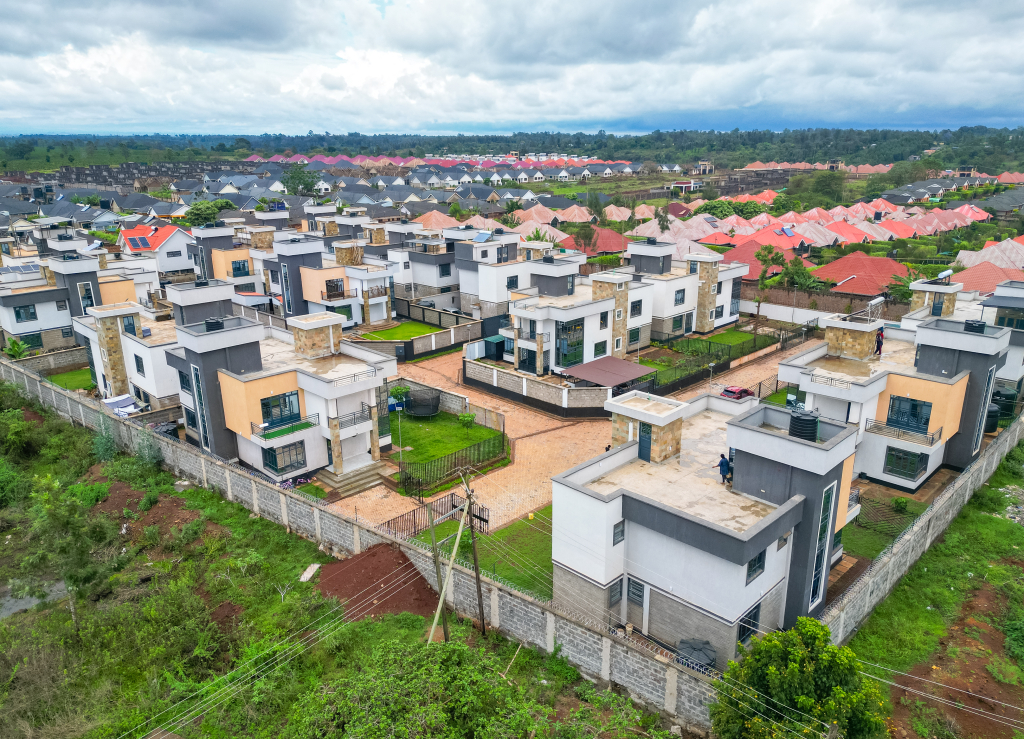
In Nairobi, informal settlements are not fringe phenomena; they house a large portion of the population and are a major component of the urban fabric. Research has shown that although informal settlements occupy a relatively small share of land, they are home to more than half of the city’s residents.
These communities exert political influence because they represent sizeable voting blocs and economic activity. At the same time, informal settlements experience tenure insecurity that affects broader land markets — including formal developments.
For example, some informal settlements spread unpredictably across undeveloped land buffers around formal neighbourhoods. Expansion into adjacent parcels can trigger:
- Negotiations with informal community representatives over land use,
- Requests for compensation from local politicians seeking support,
- Delays in infrastructure roll-out as authorities attempt to balance formal and informal interests.
This creates a governance environment where land parcels once thought stable can become politically contested, especially in rapidly urbanising zones.
Read Also: Why Parking Ratios Are Becoming a Liability in Urban Nairobi Projects
Land activism and displacement risks
Land activism in Nairobi is often driven by community groups, civil society organisations and local political actors. These forces respond to issues like:
- displacement due to new infrastructure projects,
- perceived inequities in land allocation,
- and eviction threats against longstanding informal communities.
Property that borders expanding informal settlements or areas earmarked for social claims is at risk of becoming a focal point for activism — especially if a development is perceived to encroach on community interests. These conflicts may not surface in routine title searches or typical legal reviews but can materially affect construction timelines, occupancy rates and investor returns.
Why this matters for diaspora buyers

1. Shifting leadership = shifting priorities
Local leaders often use land and housing policy as tools for constituency politics. Changes in county leadership can lead to revisions in zoning, permit processing times and infrastructure commitments, which in turn affect project feasibility and value.
2. Community resistance can delay or stall projects
Developments close to informal settlement boundaries can face vocal resistance that slows approval processes, forces design changes or increases social compensation costs. These are risks that typically surface after purchase unless proactively assessed.
3. Tenure insecurity near informal areas increases legal complexity
Even with formal titles, land near informal settlements can have overlapping claims or de facto occupation practices that complicate enforcement and tenure security.
Data snapshot: Nairobi land context (illustrative)
| Indicator | Estimate / Reality |
|---|---|
| Population living in informal settlements | ~50–60% of city residents |
| Land area occupied by informal settlements | ~5% of residential land |
| Tenure insecurity prevalence in informal contexts | High (limited formal titles; contested claims) |
| Political influence of settlement groups | Significant (election contributions & local mobilisations) |
Even though the land footprint of informal settlements appears small in percentage terms, their impact on urban governance, neighbourhood claims and political leverage is disproportionately large.
A new due-diligence blueprint for diaspora buyers

To mitigate local political and community risk in Nairobi real estate, diaspora investors should integrate political-geographic analysis into every investment decision:
🔹 Conduct local stakeholder mapping
Identify community groups, local leaders and youth associations in the area of interest. Understand their priorities and historical responses to development.
🔹 Review county land and planning policy history
Track how zoning decisions and land use plans have changed in the last 5–10 years — this can signal the stability (or volatility) of future decisions.
🔹 Consult local habitation and tenure security data
Informal settlement growth patterns can be predictive of future community claims and pressure points.
🔹 Engage urban planners and civil society early
Independent experts can provide grounded insights about neighbourhood dynamics that are invisible in title searches.
Due diligence beyond the title
For diaspora investors, the allure of diaspora property investment in Nairobi Kenya remains strong — especially given currency advantages and growth potential. But local political and community dynamics are now an essential part of due diligence that cannot be bypassed through remote buying alone.
Unlike traditional risks such as pricing or developer credibility, these dynamics are fluid, socio-politically rooted and deeply embedded in the evolving urban landscape. Incorporating them into investment evaluation protects not just legal ownership, but the future performance and resilience of the asset.
The future of Nairobi’s real estate is not written solely in land registries.
It is negotiated in county halls and community spaces — and savvy diaspora buyers know this.