
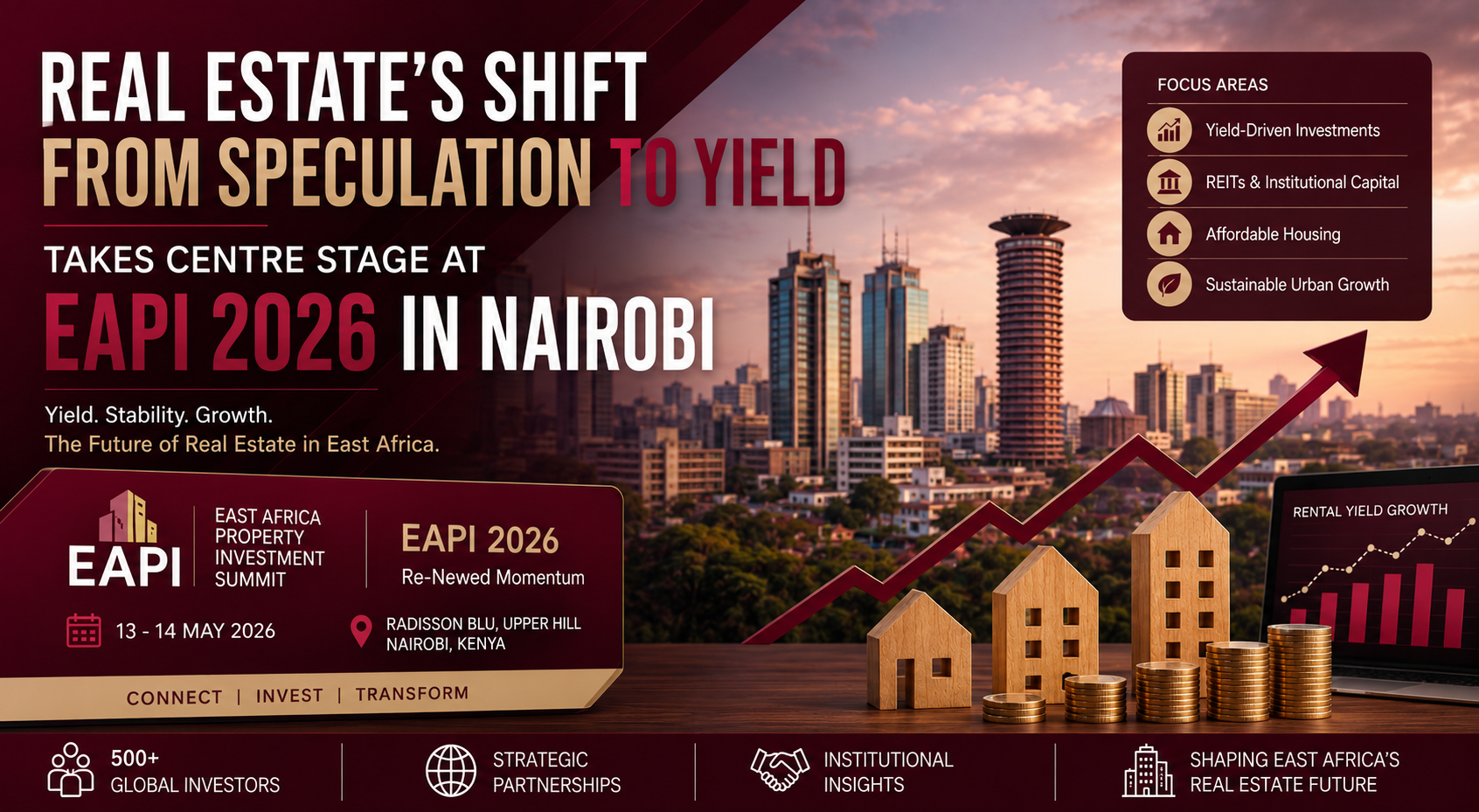
Nairobi is this week hosting one of the region’s most influential investment gatherings, the East Africa Property Investment (EAPI) Summit 2026, unfolding under the theme “Re-Newed Momentum.” Against a backdrop of tightening capital markets and rising construction costs, Kenya’s property sector is undergoing a decisive shift—from speculative price chasing to sustainable rental yields, institutional-grade assets, and income-driven real estate investment strategies.
The summit, taking place on Wednesday 13th to Thursday 14th May at Radisson Blu, Upper Hill, follows closely after the Africa Forward (France-Africa) Summit, reinforcing Nairobi’s growing status as a continental hub for real estate investment in Kenya, urban development finance, and East Africa capital markets dialogue.
Bringing together more than 500 global investors, developers, fund managers, and REIT stakeholders, EAPI 2026 is expected to focus heavily on yield optimisation, pension fund participation in real estate, REIT expansion, and blended finance structures—key drivers shaping the next phase of institutional real estate investment in East Africa.
A market splitting between yield and speculation

Fresh data from HassConsult shows Nairobi’s housing market is becoming increasingly segmented. Suburban home prices rose 1.1% in Q1, while rents increased 1.3%, underscoring continued resilience in low-density, high-demand residential zones. This reflects sustained interest in prime residential real estate in Nairobi suburbs, where supply remains constrained and demand stable.
However, in high-density urban nodes such as Westlands and Upper Hill, apartment markets are beginning to show signs of strain, with softening prices and slower absorption rates driven by oversupply in the mid-market segment. This divergence is expected to dominate discussions at EAPI 2026, particularly in sessions focused on institutional capital allocation and real estate portfolio risk management.
Institutional capital reshaping East Africa’s property sector
A key example of the sector’s transformation is the listing of Africa Property Logistics (ALP) REIT on the Nairobi Securities Exchange—the region’s first industrial and USD-denominated REIT. The listing signals a deeper shift toward the institutionalisation of real estate markets in Kenya and East Africa, where scalability, transparency, and predictable cash flows are becoming critical investment benchmarks.
As ALP CEO Raghav Ghandi notes, the sector is entering a phase where capital is increasingly flowing toward platforms aligned with urbanisation, logistics expansion, and maturing capital markets infrastructure. His session at EAPI is expected to further explore how institutional investors are recalibrating exposure toward yield-backed real estate structures.
Read Also:Nairobi Commercial Real Estate Market Recovers as Office Vacancy Rates Continue to Shrink
Suburban resilience vs urban saturation

Detached homes in affluent Nairobi suburbs such as Lavington, Karen, and Spring Valley continue to outperform, with rental yields averaging 7.4%, significantly above short-term government securities. Limited supply and sustained demand continue to support these high-end residential markets.
By contrast, apartment-heavy zones are facing increased pressure as supply outpaces demand, raising concerns about real estate oversupply in Nairobi’s mid-market residential segment. This imbalance is reshaping developer strategy toward data-driven delivery, absorption-led planning, and yield-focused development models.
Satellite towns are also emerging as key growth corridors. While sale prices dipped by 0.9%, rents rose by 1.4%, reflecting a structural shift toward rental demand in areas such as Juja, Ngong, and surrounding commuter zones. This is closely tied to broader themes of urban expansion, affordable housing demand in Kenya, and satellite town real estate development.
Developers pivot toward delivery, affordability and market alignment
Across Kenya’s property sector, developers are increasingly shifting toward affordability-led housing, disciplined project execution, and demand-aligned delivery pipelines. The focus is no longer just on construction volumes, but on market absorption, financing structure, and long-term investment sustainability.
Within this evolving landscape, developers such as Willstone Homes are positioning themselves around structured residential delivery and value-driven housing models that align with both homeownership demand and investor expectations for stable, long-term returns.
This reflects a wider industry shift in Nairobi real estate development, where execution reliability and affordability are becoming central to competitiveness. Developers who can balance pricing, delivery timelines, and financing partnerships are increasingly better positioned in a market where institutional capital is demanding greater predictability.
The broader direction highlights an important transition: housing delivery in Kenya is no longer purely supply-driven—it is increasingly shaped by investment discipline, affordability constraints, and yield-based performance metrics.
Yield becomes the dominant investment lens

Across EAPI 2026 discussions—spanning REITs, pension capital, private equity, and blended finance—the dominant narrative is clear: yield is replacing speculation as the primary driver of real estate investment decisions in East Africa.
This is accelerating capital flows toward:
- Defensive residential assets in established suburbs
- Serviced and rental-focused developments
- Mixed-use income-generating real estate
- Structured REIT platforms and institutional-grade funds
At the same time, speculative apartment developments are facing growing scrutiny as investors reassess risk in an environment of rising costs and uneven demand absorption.
Outlook for East Africa’s property market
As Nairobi continues to expand, the intersection of real estate investment in Kenya, urban housing demand, and institutional capital inflows is becoming increasingly pronounced. The data emerging ahead of EAPI 2026 suggests a market entering a more disciplined phase—where cash flow stability, occupancy performance, and yield efficiency are becoming more important than rapid price appreciation.
As EAPI Director Murray Anderson-Ogle observes, the summit’s discussions are expected to shape long-term capital allocation trends across the region, reinforcing East Africa’s position as one of the continent’s most dynamic real estate investment frontiers.
Ultimately, the sector is moving toward a clearer structure: less speculation, more discipline, and a stronger focus on yield-backed, delivery-driven real estate growth in Kenya and the wider East African market.