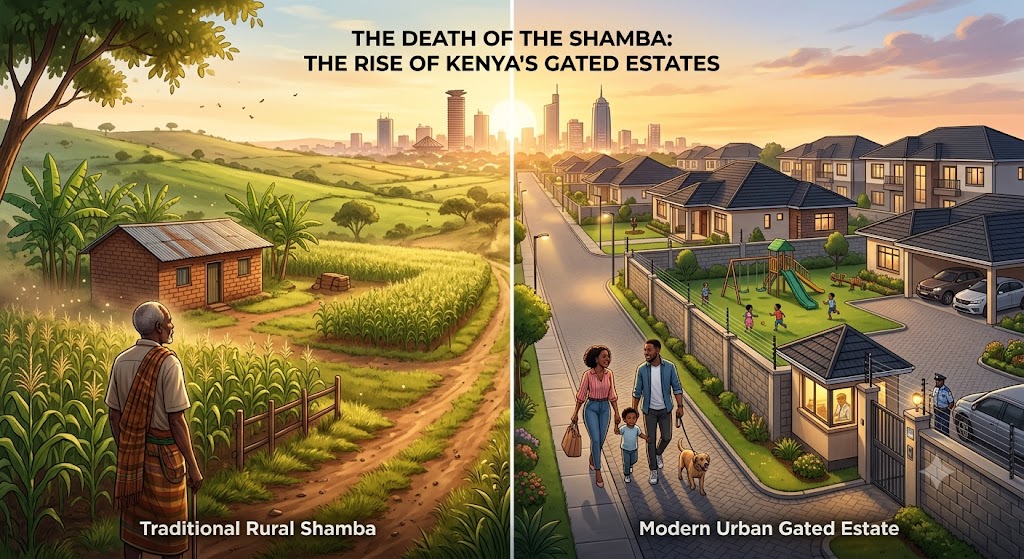
There is an invisible, profound shift happening across Kenya. For generations, the ultimate mark of success for a young professional in Nairobi was simple: secure a job in the city, buy a piece of ancestral land back in the village, build a rural home, and eventually retire there.
But as we navigate the later half of the 21st century, that generational contract is quietly breaking.
Today, young professionals are making a different choice. They are selling off inherited rural plots and investing that capital into gated communities in Nairobi outskirts. Why are they fleeing organic village life, only to pay a premium for a manufactured community along Kenyatta Road, Juja, or Kangundo Road?
The answer reveals a fascinating paradox of modern sociology and Kenya real estate trends.
Read Also:The Thika Road Growth Engine: Why Kenyatta Road, Juja, and Mang’u Dominate Suburban Equity
The Rural Reality: The Fragmentation of Ancestral Land
The traditional nuclear family structure in rural Kenya is weakening. Historically, the village functioned as a self-sustaining welfare state bound by kinship and shared lineage. However, rapid urbanization and economic pressures have transformed these social dynamics.
When young men get jobs in Nairobi, the expectation to continually fund the rural ecosystem—frequently called “social taxation”—can feel overwhelming. For many, selling an ancestral piece of land is an act of individual financial sovereignty.
But this creates a secondary socio-spatial problem:
- The “Newcomer” Disconnect: When ancestral land is commodified and sold to outsiders, the traditional communal bond suffers a shock.
- High Walls, Low Integration: New buyers often purchase these rural plots purely for privacy, retirement, or speculation. They erect high perimeter walls, stay detached from local welfare committees, and treat the village as an isolated asset rather than a shared community.
As the organic bond of the village dissolves, the modern city dweller is left in a psychological deficit. Humans are hardwired for connection; total isolation in a chaotic city breeds anxiety.
The Urban Solace: Manufacturing the Modern “Village”
To cure this isolation, the Nairobi middle class is turning heavily toward controlled development estates. They are bypassing standalone, isolated plots in favor of master-planned ecosystems.
[Capital Outflow]                               [Capital Inflow]
  Rural Land Sales   --->  DECENTRALIZATION  --->   Urban Periphery
(Ancestral Fragments)                             (Gated Estates)
This isn’t just a lifestyle choice; it has completely flipped the script on property investment in Kenya. Premium developers are no longer just selling square footage or structural finishes; they are explicitly selling social infrastructure as an amenity.
When you look at modern 3-bedroom bungalows for sale along Kangundo Road or 4-bedroom maisonettes on Kenyatta Road, the marketing brochures don’t just highlight granite countertops. They headline:
- 24/7 Security & Controlled Access: Replacing the traditional protection of the village community with professionalized estate security and CCTV surveillance.
- Shared Ambiance & Green Spaces: Dedicated kids’ play areas and estate parks where children can socialize safely—replicating the open fields where past generations played in the village.
- Homeowners Associations (HOAs): Serving as the new “estate elders.” Conflicts, maintenance dues, and rules (like capping noise levels) are managed through corporate governance, ensuring property value stays protected.
Read Also: The Thika Road Growth Engine: Why Kenyatta Road, Juja, and Mang’u Dominate Suburban Equity
The Real Estate Playbook: Trading Acreage for Value
From a financial and real estate investment Kenya perspective, this shift makes perfect macroeconomic sense.
Savvy buyers—including a massive wave of diaspora property buyers—are realizing that raw, unmanaged acreage in distant rural areas yields very little capital appreciation. By liquidating those fragments and placing a down payment on a turnkey home in a gated community, they are shifting their wealth into high-demand growth corridors.
| Feature | The Traditional Rural Shamba | The Modern Urban Gated Estate |
| Asset Type | Idle, fragmented land | Liquid, land-backed property |
| Governance | Informal village customs | Strict, legally binding HOA codes |
| Security | Reliance on neighbors/village layout | Perimeter walls, electric fences, 24/7 guards |
| Infrastructure | Unpredictable municipal utilities | Private boreholes, dedicated transformers, cabro roads |
Ultimately, the modern Kenyan is not abandoning the concept of community; they are simply changing how they pay for it. They are trading the complex, emotional obligations of the ancestral village for a clean, predictable, and secure contract in a modern gated estate. It is community, curated.