When you look at a raw piece of land today, it is easy to see only what immediately surrounds it: quiet farms, a few scattered houses, a dirt road, or a lone local kiosk.
But land does not exist in a static bubble. Neighbourhoods evolve.
What is peaceful farmland today can become a vibrant residential hub tomorrow. Scattered houses consolidate into organized estates. Retail services follow the expanding footprint of residents. Schools, clinics, and infrastructure follow growing populations. Eventually, high-rise apartments, corporate offices, and commercial centres completely redefine the character of an area.
This is the neighbourhood life cycle—and understanding it will fundamentally transform how you evaluate land investment in Kenya.
For buyers exploring emerging growth corridors around Nairobi and its satellite towns—such as Juja, Mang’u, Ruiru, Thika, and the surrounding bypass routes—this framework provides a blueprint for spotting value long before the rest of the market catches on.
Read Also: What Happens to a Family’s Finances When the House Is Finally Paid Off?
The 7 Stages of the Neighbourhood Life Cycle

While there is no rigid clock for how fast an area develops, growing urban peripheries in Kenya broadly pass through seven distinct evolutionary phases.
Farmland ➔ Scattered Homes ➔ Estates ➔ Shops & Services ➔ Schools & Institutions ➔ Apartments ➔ Full Commercialisation
| Stage | Key Physical Indicators | Economic Driver | Risk / Return Profile |
| 1. Farmland | Agricultural plots, dirt tracks, minimal utilities | Land banking & speculative positioning | Higher risk / Highest long-term appreciation |
| 2. Scattered Homes | Individual owner-occupiers, private boreholes | Early organic population inflow | Moderate-high risk / Strong growth potential |
| 3. Estates | Developer-led gated communities, uniform housing | Inflow of organized middle-class buyers | Balanced risk / High demand liquidity |
| 4. Shops & Retail | Hardware stores, supermarkets, pharmacies, petrol stations | Commercial services following population density | Lower risk / Steady capital appreciation |
| 5. Institutions | Schools, health centres, places of worship, police posts | Full-lifecycle community infrastructure | Moderate risk / Solid rental & resale demand |
| 6. High-Density | Low-rise and mid-rise apartment blocks | Land scarcity forcing vertical development | Low risk / Strong rental yields |
| 7. Commercialisation | Office blocks, bank branches, mixed-use complexes | Strategic arterial node transformation | Institutional risk profile / Peak asset valuation |
Stage 1: Farmland — Before the Transformation
Most urban centres in Kenya began as agricultural blocks. In this phase, you will see expansive acreage, livestock grazing, and sparse permanent construction. Infrastructure is rudimentary: unpaved feeder roads, limited grid power, and distant commercial centres.
To a casual observer seeking an immediate residential home, Stage 1 looks undeveloped. But underneath the surface, key growth catalysts may already be forming:
- Government plans for bypasses or arterial road expansions.
- Decentralisation of industrial or educational hubs from main cities.
- Rising affordability pressure in neighbouring, fully developed towns.
Investor Takeaway: This is the prime window for land banking. You are not buying to build immediately; you are acquiring a strategic position ahead of future demand.
Stage 2: Scattered Homes — The First Signs of Organic Growth

Transformation begins when individual buyers acquire subdivided plots and start constructing private family homes.
One house becomes five; five become twenty. To a passerby, the area still feels rural, but the demographic reality is changing rapidly.
Why this stage matters:
- Demographics drive demand: New households require food, transport, water, building materials, and daily necessities.
- Property re-evaluation: A plot that sat adjacent to a farm now sits adjacent to occupied homes. The physical coordinates of the land haven’t changed, but its economic context has shifted permanently.
Stage 3: Estates — The Population Density Engine
Once organic home building proves an area’s viability, commercial property developers step in. They consolidate parcels to construct gated communities, serviced plots, and organized housing schemes.
This transition introduces population density—the single most critical engine of real estate appreciation.
A neighbourhood home to 500 structured households possesses an entirely different commercial value profile than one with 20 scattered residences. This surge of concentrated consumers acts as a magnet for business capital.
Stage 4: Retail & Commercial Services Follow the Footsteps
As residential density reaches critical mass, commercial enterprises move in to serve daily household needs.
You will observe a distinct sequence of commercial arrivals:
- Construction & Daily Goods: Hardware stores, local eateries, boda boda stages, mobile money kiosks.
- Convenience Retail: Supermarkets, bakeries, pharmacies, car washes.
- Financial & Professional Services: Bank ATMs, fuel stations, private clinics, dining establishments.
This creates a self-reinforcing economic loop:
$$\text{More Homes} \longrightarrow \text{Higher Population} \longrightarrow \text{More Services} \longrightarrow \text{Greater Convenience} \longrightarrow \text{Increased Housing Demand}$$
Stage 5: Schools & Community Institutions Arrive
When an area evolves from a place where people merely construct houses to a place where families raise children, major institutional investments follow.
Private and public schools, medical facilities, places of worship, recreational parks, and local administrative offices are established.
When evaluating land investment in Kenya, buyers in Stage 5 ask essential livability questions:
- How far is the nearest quality school?
- Where are the regional healthcare centres located?
- Is public transport (matatu routes) reliable and accessible?
- How long is the commute to major employment nodes?
At this stage, land value is heavily dictated by accessibility and proximity to daily social amenities.
Read Also: Why Waste Infrastructure Dictates Property Value in Nairobi and Satellite Towns
Stage 6: Apartments & Vertical Infill Development
As land becomes scarcer and plot acquisition costs rise, horizontal expansion slows down, and development moves vertically.
Single-family plots are re-zoned or redeveloped into multi-storey apartment buildings, townhouses, and mixed-use structures. The population density multiplies without expanding the physical borders of the neighbourhood.
Planning & Regulatory Warning: Success in Stage 6 depends heavily on zoning regulations, county government spatial plans, utility capacities (water mains and sewer lines), and structural approval frameworks. Always verify permitted land use with local county planning offices before banking on high-density development.
Stage 7: Full Commercialisation — The Urban Node Transformation
Eventually, prime plots along major transit corridors transition away from purely residential use toward high-value commercial uses: retail malls, corporate branch offices, medical complexes, and service centers.
The core real estate principle at work:
The physical dimensions of a $40 \times 60$ ft or $50 \times 100$ ft plot never change. However, the economic productivity of the surrounding environment multiplies exponentially—and so does the land’s market value.
Evaluating Land Investment in Kenya: The Due Diligence Framework
To distinguish genuine growth corridors from speculative hype when exploring satellite markets like Juja, Ruiru, Mang’u, or Thika, evaluate these seven core fundamentals:
- Accessibility: Are there existing or funded dual-carriageways, bypasses, or rail links connecting the area to major commercial hubs?
- Infrastructure Deployment: Is grid electricity, municipal water piping, or fiber-optic broadband actively expanding along feeder roads?
- Organic Building Activity: Are private individuals and developers actively laying foundations, or are plots sitting completely untouched?
- Anchor Amenities: Are reputable school brands, health networks, or retail chains acquiring sites in the vicinity?
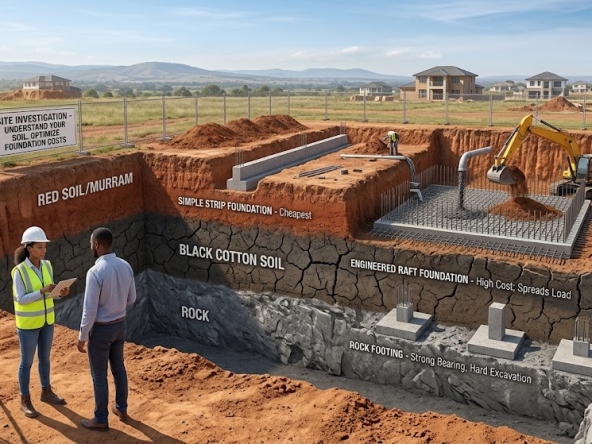
- Topography & Soil Profile: Is the terrain buildable without excessive sub-structure costs (e.g., firm red soil versus deep black cotton soil)?
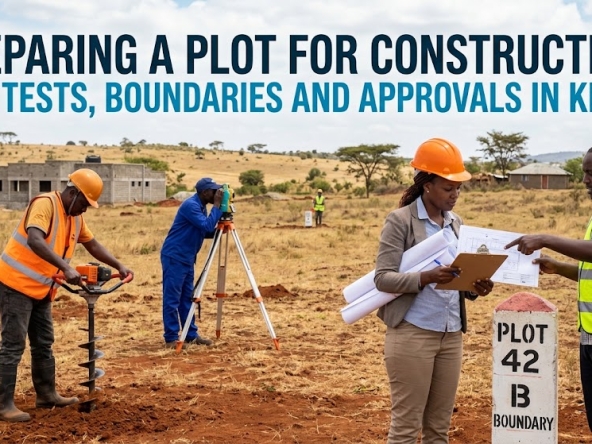
- Title Integrity & Ownership: Are titles clean, unencumbered, and verifiable via official land registries?
- Local Spatial Planning: What does the local county physical development plan indicate regarding future zoning and infrastructure corridors?
Changing the Core Real Estate Question
Traditional property conversations usually revolve around one basic metric:
- “How much does this plot cost today?”
A far more strategic approach to land investment in Kenya asks:
- “What economic forces are converging around this plot right now?”
- “What stage of the neighbourhood life cycle will this area enter over the next 5 to 10 years?”
Real estate appreciation is fundamentally tied to human migration, infrastructure spending, and urban expansion. Where population moves, housing follows; where housing grows, commercial capital settles.
Read Also: Nairobi Developers Are Moving Again: What the New 2026 Building Rules Mean for Property Investors
Investing in the Story, Not Just the Soil
A piece of land is never just a set of physical dimensions or a title deed number. It is an anchor within a evolving community, an expanding road network, and a growing regional economy.
When buying land, you are not simply purchasing what exists today—you are securing a stake in what the neighbourhood will become tomorrow.
At Willstone Homes, we empower buyers with market insights to help them navigate Kenya’s dynamic real estate landscape with clarity. Understanding the neighbourhood life cycle ensures that every investment you make is grounded in strategic vision, sound fundamentals, and long-term value creation.