You can inspect a plot’s title deed, verify its boundaries, and check the access road. But the single factor that most impacts what your house will cost to build is completely invisible: the soil beneath it.
Two plots of the exact same size, located just a few kilometres apart, can require completely different foundations. One plot may allow a builder to dig simple trenches and pour concrete. The other may demand heavy machine excavation, tonnes of imported fill, or a specialized foundation design.
That structural difference shows up as real money during construction—and as severe wall cracks years later if it is ignored.
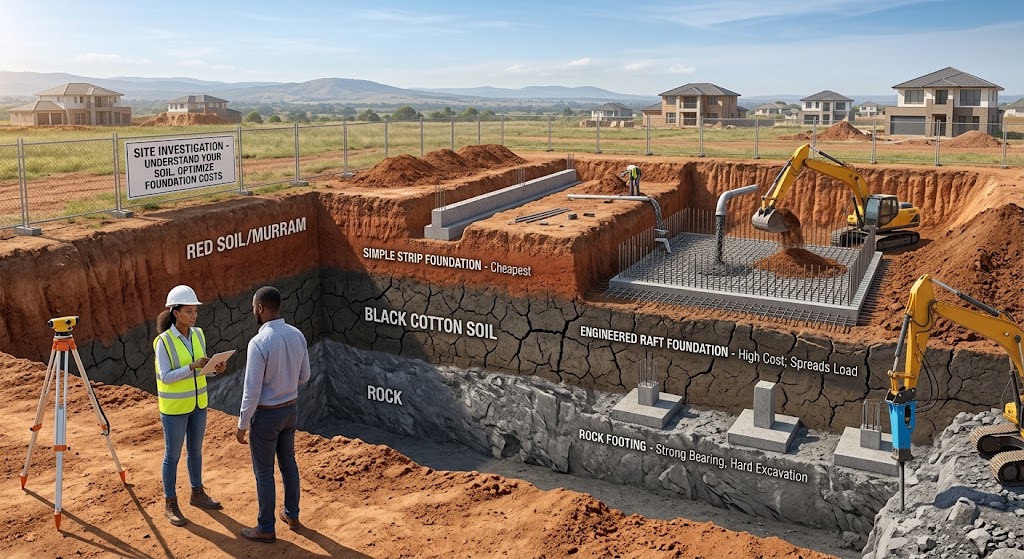
The 3 Common Ground Types You’ll Encounter
| Ground Type | What It’s Like | What It Means for Your Foundation |
| Murram / Red Soil | Firm, well-draining, reddish | Easiest & cheapest to build on; supports standard strip foundations. |
| Black Cotton Soil | Dark, sticky when wet, cracks when dry | Costliest; requires soil removal, raft slabs, or deep foundations. |
| Rock | Hard, solid surface | Strong bearing capacity, but excavation requires heavy machinery or blasting. |
1. Murram and Red Soil: The Builder’s Friend
Murram and red soils have excellent load-bearing capacity. They allow for the simplest, most affordable foundation type—typically a standard strip foundation for bungalows and maisonettes.
Trenching is quick and straightforward, minimal soil needs to be carted away, and the building remains stable over time without unpredictable ground movement.
2. Black Cotton Soil: Looks Fertile, Builds Expensive
Black cotton soil is dark and nutrient-rich, making it great for agriculture—but notoriously difficult for real estate development.
Technically known as expansive clay, it acts like a sponge: it soaks up water during the rainy season and swells, then shrinks and forms deep fissures during dry spells. This continuous up-and-down movement will break floor tiles, peel paint, and crack walls if the foundation isn’t specifically engineered for it.
Where is it found?
Black cotton soil is widespread across several regions in Kenya, including parts of Kajiado, Nairobi, Kiambu, Machakos, and the Rift Valley. Around Nairobi, it is particularly common in areas such as:
- Kitengela, Syokimau, & Athi River
- Ruai, Kamulu, & Joska (along Kangundo Road)
- Select pockets of Ruiru
How builders handle black cotton soil:
- Remove and Replace (Scooping): Digging out the clay layer entirely and refilling the excavation with compacted murram or hardcore fill. This is cost-effective when the clay layer is shallow (up to $1.5\text{–}2.0\text{ metres}$).
- Raft Foundation: A thick, stiff concrete slab spreads the weight of the house evenly, ideal where the clay layer is too deep to excavate economically.
- Piles or Suspended Foundations: Concrete columns extend deep into stable ground, keeping the floor slab elevated so ground movement doesn’t push directly against the structure.
Note: Standard strip foundations laid directly onto black cotton soil are not recommended, as ground movement will inevitably cause structural cracking.
3. Rock: Strong, But Slow to Dig
Rocky ground offers incredible structural support, but cutting foundation trenches into rock requires heavy machinery, hydraulic breakers, or controlled blasting.
While you won’t need expensive backfill materials, excavation costs per cubic metre are significantly higher on rock. Where rock lies close to the surface, site levels and drainage channels must also be carefully planned.
So How Much More Does Black Cotton Soil Cost?
Foundation work generally accounts for 11% to 16% of your total construction budget. For example, a standard 3-bedroom house ($\approx 120\text{ square metres}$) might have a base foundation cost of around KSh 800,000 on good red soil.
On black cotton soil, substructure costs typically rise by 15% to 25%+ due to extra excavation, soil hauling, and imported fill material.
- The Difference: That expansive soil can easily add an extra KSh 120,000 to KSh 200,000+ to your foundation budget.
Keep in mind: These figures are ballpark estimates. Your actual cost will depend on the exact depth of the clay layer, water table levels, structural design, and season of excavation.
Why a Soil Test is the Best Money You’ll Spend
A basic site soil test or trial pit investigation typically costs KSh 15,000 to KSh 25,000 (with comprehensive multi-borehole tests ranging higher depending on project size).
A soil test tells your engineer:
- Exactly how deep the problematic layer goes.
- Which foundation design is safest for your building.
- Whether you need full soil replacement or an engineered slab.
Investing in a soil test prevents two costly mistakes: under-engineering (which leads to cracked buildings) and over-engineering (such as paying for deep piles when a simple raft slab would have sufficed).
7 Practical Ways to Inspect a Plot Before Buying
You don’t need a laboratory to spot immediate warning signs:
- Examine the soil surface: Dark, sticky mud during rains or coarse, reddish earth gives immediate clues.
- Visit during dry weather: Expansive black cotton soil will display wide, polygon-shaped surface cracks.
- Inspect neighbouring houses: Look closely for diagonal wall cracks, uneven floors, or freshly patched masonry nearby.
- Check trial pits and quarries: Exposed soil cuts along roads or local drainage trenches show what lies beneath the topsoil.
- Talk to local builders: Ask neighbours how deep they had to dig before hitting stable ground.
- Check drainage and septic systems: Expansive soil can crush or shift unreinforced septic tanks; locals will know what works.
- Request prior soil reports: Ask the vendor for existing soil test results, or request permission to dig a small trial pit before completing the purchase.
Buying a Plot with Black Cotton Soil? Don’t Panic.
A plot with black cotton soil isn’t a bad plot—it’s simply a plot that demands proper engineering.
To build safely and stay on budget:
- Commission a soil test and consult a qualified structural or geotechnical engineer.
- Factor the additional foundation/substructure cost into your overall land purchase budget.
- Ensure effective surface drainage around the perimeter of the house to keep water away from the foundation.
- Work with an experienced contractor who has a proven track record on expansive ground.
Frequently Asked Questions
What is black cotton soil, and why is it a problem?
It is a clay-rich soil that expands significantly when wet and shrinks/cracks when dry. This continuous movement causes floor tiles to lift and wall masonry to crack if the foundation isn’t engineered for expansion.
How much extra does it cost to build on black cotton soil?
Foundation costs on black cotton soil generally increase by 15% to 25%+ compared to standard red soil, primarily driven by machine excavation, soil disposal, and imported murram/hardcore fill.
How much does a soil test cost in Kenya?
Basic trial pit soil investigations typically cost KSh 15,000 to KSh 25,000, while comprehensive multi-borehole lab reports range from KSh 30,000 to KSh 80,000+ depending on plot size and structural requirements.
Is murram good for building?
Yes. Murram and red lateritic soils offer excellent load-bearing capacity, good drainage, and allow for standard, cost-effective strip foundations.
Disclaimer: This article provides general educational information and does not replace professional structural engineering advice. Always conduct a site-specific geotechnical investigation prior to construction.