
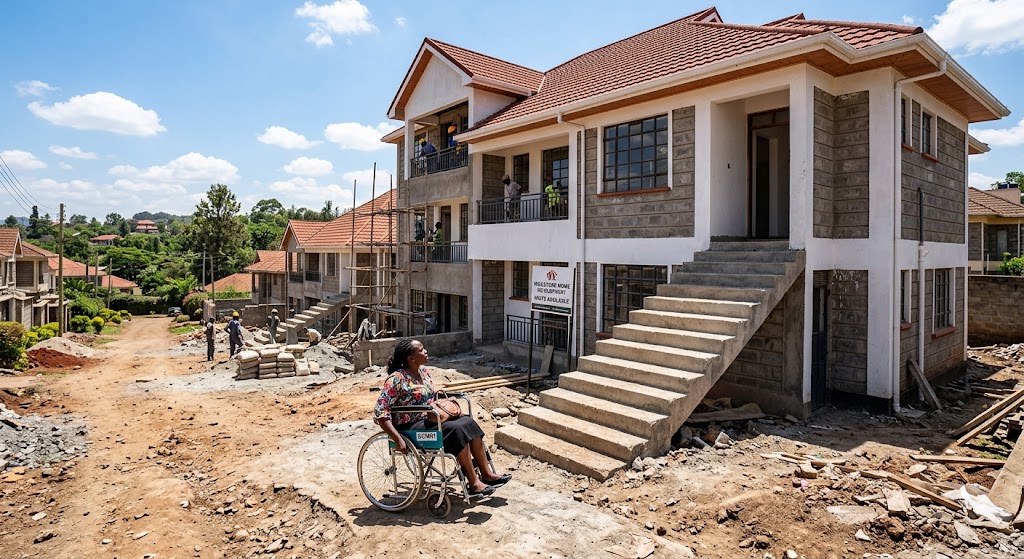
Kenya’s property market has made considerable progress in architectural design, with developers increasingly investing in attractive finishes, spacious living rooms, landscaped compounds and impressive exterior designs. However, one important consideration appears to receive far less attention: accessibility for persons living with disabilities. As demand for Homes for Sale in Kenya continues to attract different categories of buyers, residential design should reflect the needs of a wider population rather than assume that every homeowner or visitor has unrestricted mobility.
While ramps, wheelchair-friendly entrances and accessible washrooms are increasingly associated with hospitals, shopping malls, government offices and corporate buildings, many residential properties still overlook these features. This raises an important question: Why should accessibility be treated as a requirement for commercial and public buildings but not considered an essential aspect of residential planning?
After all, people with disabilities do not live exclusively in institutions, work only in offices or shop in malls. They have families, friends, relatives and social lives. They visit other people’s homes, attend family gatherings and participate in ordinary community activities like everyone else.
A Beautiful Home That Some Visitors Cannot Enter
Consider a family that has invested millions of shillings in building a beautiful bungalow. The house has an impressive entrance, polished floors, modern fittings and a well-maintained compound. However, the entrance has several steps, the doorways are too narrow for wheelchair access, and there is no suitable pathway connecting the parking area to the main entrance.
For a visitor using a wheelchair, entering that home could become an impossible task without assistance. Even someone using crutches following an accident could struggle with the steps and uneven pathways.
The problem extends beyond wheelchair users. An elderly parent with limited mobility, a relative recovering from surgery or a visitor with a visual impairment may encounter difficulties navigating a residential property that was designed without accessibility in mind.
This is an important consideration for buyers comparing Houses for Sale in Nairobi, Bungalows for Sale in Kenya and other Residential Properties in Kenya. A property’s value should not be assessed exclusively through its location, number of bedrooms, finishing standards and asking price. Its functionality and ability to accommodate different users also deserve attention.
What Does Kenyan Law Say About Accessibility?
Kenya has a legal framework that recognises the rights of persons with disabilities and provides standards for accessibility in buildings.
Article 54 of the Constitution of Kenya, 2010, guarantees the rights of persons with disabilities, including dignity, respect and reasonable access to all places, public transport and information. This establishes accessibility as an important constitutional consideration rather than simply a matter of architectural preference.
The Persons with Disabilities Act, 2025, which replaced the previous 2003 legislation, further strengthens this framework. Section 30 recognises the right of persons with disabilities to a barrier-free and disability-friendly environment. It also requires public and private institutions to implement minimum accessibility standards for facilities and services open or provided to the public.
The Act addresses accessible entrances, pathways, parking facilities, bathrooms and other building features. It also places responsibility on relevant government agencies to consider accessibility when approving building plans.
Another important piece of legislation is the National Building Code, 2024, which came into operation on 1 March 2025. Part XX, particularly paragraphs 352 and 353, addresses accessibility for persons living with disabilities. It requires buildings to be designed to facilitate access and use of their facilities. It also provides for an accessible route from the property boundary to at least one entrance, without steps or other barriers that prevent wheelchair access.
The Code contains a limited exemption for certain single-storey, owner-occupied residential buildings constructed using locally available materials and designs influenced by local culture and traditions. This is important because the requirements should not be presented as applying identically to every privately owned family dwelling.
Nevertheless, the direction of Kenya’s legal framework is clear: accessibility must be considered in building design, particularly in developments and facilities covered by the applicable standards.
Why Does Accessibility Remain an Afterthought?
One explanation is the assumption that disability-friendly infrastructure is primarily necessary in buildings that receive large numbers of visitors. Developers may consider ramps, accessible washrooms and wider entrances essential in a shopping centre or office complex but less important in a residential development.
This overlooks the social function of homes. A residential property is not simply a private space occupied by its owner. It is also where families entertain guests, receive relatives, celebrate important occasions and maintain relationships.
Another challenge is the tendency to prioritise appearance over functionality. Across the Real Estate in Kenya sector, developers and homeowners can spend considerable resources on decorative entrance steps, elaborate landscaping and raised verandas without considering whether these features will make the property difficult to access for someone with limited mobility.
For buyers exploring Modern Homes for Sale in Kenya, this presents an opportunity to look beyond attractive photographs and impressive finishing. A thoughtfully designed home should combine aesthetics, convenience, safety and accessibility.
There is also a financial consideration. Some homeowners may assume that accessibility features are expensive additions that can be installed only when a specific need arises. Yet incorporating a properly designed entrance ramp, wider doorways and suitable pathways during the initial construction stage can be easier and more economical than modifying a completed building.
Ultimately, accessibility should be part of the original architectural conversation rather than an emergency adjustment.
Why Is Enforcement Still Weak?
The existence of building regulations does not automatically translate into compliance. One of the challenges facing Kenya is the division of responsibilities between national institutions and county governments.
County governments play an important role in development approvals, inspections and building control, while national institutions establish standards and oversee aspects of the construction industry. The National Construction Authority and the National Council for Persons with Disabilities also have responsibilities within their respective mandates.
However, inspection capacity, technical expertise, funding and coordination remain challenges.
The problem was highlighted in March 2026 when the Senate examined complaints about inaccessible public buildings in Mombasa. At least seven facilities were identified as having serious accessibility shortcomings. During the proceedings, the Ministry of Lands, Public Works, Housing and Urban Development acknowledged enforcement gaps and weaknesses in county capacity.
The discussion exposed an uncomfortable reality: even buildings intended to serve the public can remain inaccessible despite existing legal requirements.
If enforcement is struggling in public institutions, it raises legitimate questions about how consistently accessibility requirements are assessed in private residential developments.
There is a need for more consistent inspections, stronger coordination between regulators and county governments, and greater accountability where approved building plans are not followed.
What Should Residential Developers Be Doing Differently?
Accessibility does not necessarily mean turning every residential property into a specialised facility. It means making reasonable design decisions that allow people with different mobility needs to use and navigate spaces more comfortably.
Developers offering Homes for Sale in Nairobi, Gated Communities in Kenya and other residential developments should consider step-free entrances, appropriately designed ramps, wider doorways, accessible pathways and sufficient movement space within common areas. Bathrooms should also be planned with the possibility of grab rails and other accessibility adaptations in mind.
In multi-storey residential developments, accessibility requires particular attention to lifts, entrances, corridors, parking areas and shared facilities. Emergency evacuation arrangements should also account for occupants with disabilities.
These considerations are relevant to Planned Residential Developments in Kenya as well. Accessible pathways should connect homes to shared amenities, parking spaces and other communal facilities. Installing a ramp at the main gate is of little value if a wheelchair user cannot comfortably navigate the rest of the development.
The broader principle is known as universal design. It encourages the creation of environments that can be used by as many people as possible, regardless of age or physical ability. Its benefits extend to elderly residents, pregnant women, young children and people temporarily recovering from injuries.
Building Homes That Welcome Everyone
The success of a residential development should not be measured exclusively by its architectural appearance, finishing standards or selling price. The ability of different people to access and comfortably use the property is equally important.
As Property Developers in Kenya continue to respond to changing buyer expectations, accessibility deserves a place alongside security, infrastructure, location and construction quality. It should also become part of the conversation for anyone searching for Affordable Homes in Kenya or planning to build a family home.
Homeownership is about creating spaces where people live, raise families, welcome visitors and build relationships. A home that unnecessarily excludes someone because of a disability raises questions about the thought that went into its design.
Kenya already has constitutional protections, disability legislation and building standards addressing accessibility. The challenge now is ensuring that these provisions translate into better design decisions and meaningful enforcement.
Residential developers, architects, county planning departments and homeowners all have a role to play. Accessibility should not be viewed as a specialised feature reserved for hospitals, corporate buildings and government institutions. It should be recognised as an important consideration in creating functional, welcoming and future-ready homes.
A person does not need to own a house or live in it to deserve access to it. Sometimes, all they want is to visit someone they love without having to struggle to get through the front door.
Editorial sources for fact-checking: