
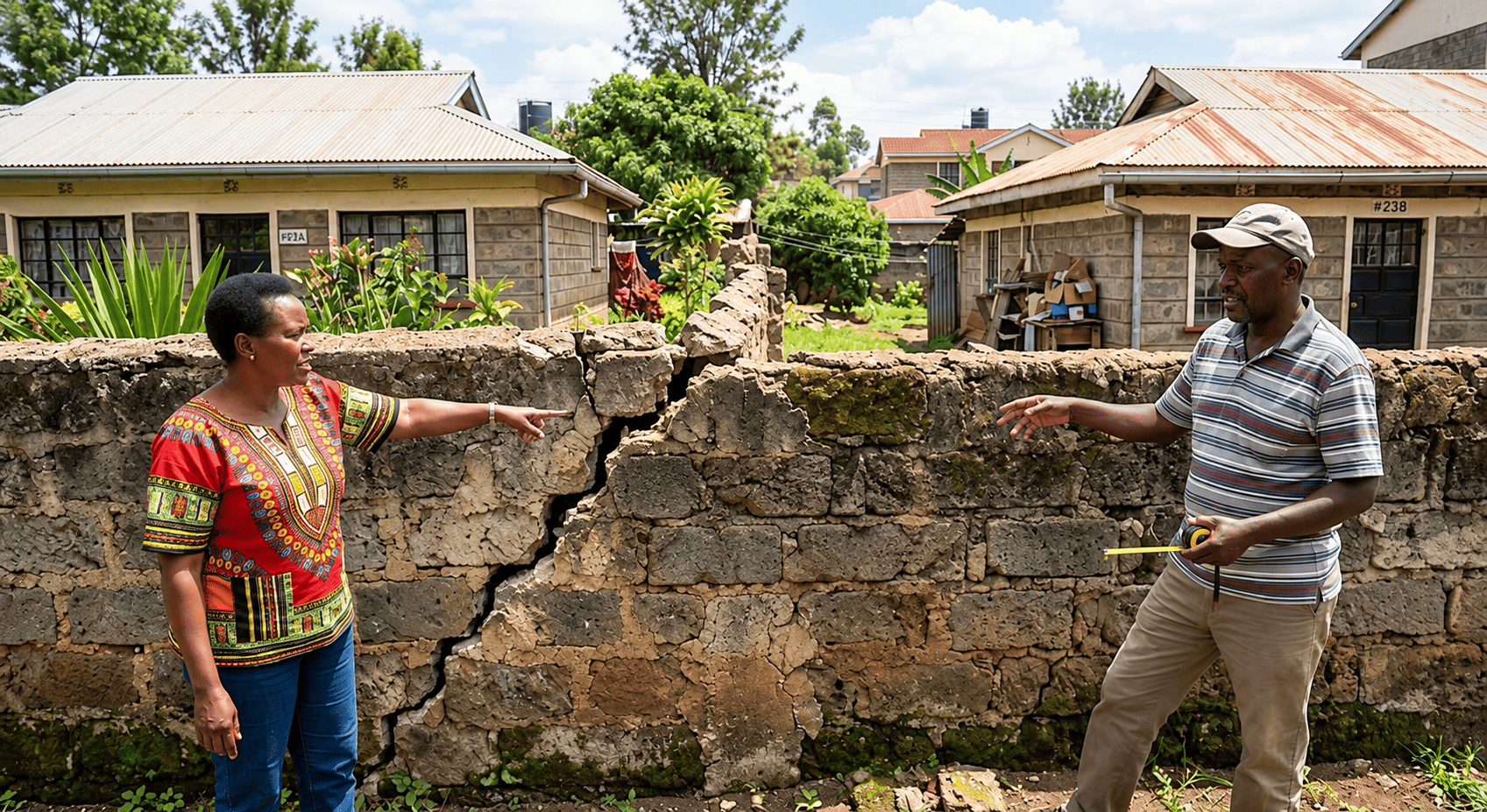
Two adjacent plots, one perimeter wall, and almost never a written agreement stating who is legally responsible for its upkeep.
It is one of the most frequent sources of friction in Kenyan residential estates—and one of the least scrutinised issues before buyers close a property deal.
Whether a stone wall begins to lean after heavy rains, structural cracks appear along the mortar joints, or complete rebuilding becomes necessary, neighbours often find themselves at an awkward impasse. Understanding how boundary wall ownership in Kenya works before a dispute arises protects your financial liability and safeguards your relationship with the person living next door.
The General Rule of Boundary Wall Ownership in Kenya
Where a boundary wall, stonework perimeter, or live fence sits directly along the dividing line between two private properties, it is treated as jointly owned property (tenancy in common of the wall structure).
According to guidelines supported by the Kenya Alliance of Resident Associations (KARA) and prevailing common law principles applied across Kenyan courts:
- Equal Joint Ownership: Both property owners share equal title to the physical barrier erected along the boundary line.
- Shared Financial Responsibility: Both neighbours are equally liable for necessary maintenance, routine upkeep, and structural repairs.
- No Unilateral Alterations: Neither owner may raise, lower, extend, paint, chip away, or demolish the wall without the prior written consent of the adjoining neighbour.
Legal Context: While Kenya does not have a single, standalone “Party Wall Act” like some jurisdictions, boundary wall governance draws from established land rights, common law nuisance, strict liability under the Law of Torts, and local physical planning regulations enforced by county governments.
Read Also: What Happens to Your Plot If the Seller Is Married? Spousal Consent and Land Sales in Kenya
What “Shared Responsibility” Means in Practice
Understanding legal rights requires knowing how costs and decisions are split when maintenance or damage occurs:
                      PROPERTY A                 PROPERTY B
              ┌─────────────────────────┬─────────────────────────┐
              │                         │                         │
              │   Private Plot Line A   │   Private Plot Line B   │
              │                         │                         │
              └─────────────────────────┴─────────────────────────┘
                                   ▲         ▲
                                   │  SHARED │
                                   │  WALL   │
- Cost Splitting for Standard Repairs: Routine structural maintenance—such as re-plastering, damp-proofing, or rebuilding due to natural age—is split 50/50 between both plot owners.
- Liability for Negligence or Modification: If who repairs boundary wall Kenya becomes a dispute because one neighbour damaged the wall (e.g., digging an unreinforced trench too close to the foundation, mounting heavy water tanks, or backing a vehicle into it), that neighbour absorbs 100% of the repair costs.
- Unilateral Upgrades Are Self-Funded: If you decide to raise the wall height purely for your own enhanced privacy or add decorative cladding on your side, you must obtain your neighbour’s consent and cover the expenses yourself unless they voluntarily agree to co-fund it.
- Acts of Nature (Force Majeure): If a storm, lightning strike, or falling tree destroys a shared perimeter wall, both neighbours share the restoration cost equally if both benefit from the renewed security barrier.
Shared Wall vs. Private Wall: Spotting the Difference
Not every wall located near a property boundary is a shared wall. The actual legal status depends on where the structure sits relative to official cadastral survey beacons.
| Wall Type | Physical Location | Ownership Status | Repair & Alteration Rights |
| Party / Shared Boundary Wall | Straddles the exact centerline of the property boundary. | Jointly owned by both neighbours. | Shared 50/50 responsibility; mutual consent required for any changes. |
| Private Boundary Wall | Erected entirely within the boundary lines of Plot A (even by a few millimetres). | Owned 100% by Property A’s owner. | Owner of Plot A bears all costs; neighbour on Plot B has no structural alteration rights. |
| Encroaching Wall | Crosses over the surveyed boundary line onto the adjoining land. | Constitutes legal trespass. | The builder must rectify the encroachment or compensate the affected owner. |
Why Boundary Disputes Escalate During Property Resale
Unresolved perimeter wall issues frequently derail smooth property transactions or create immediate friction for new homeowners:
- Inherited Disputes: Buyers inherit existing physical defects (leaning structures, water damage, foundation shifting) and unresolved neighbour conflicts along with the land title.
- Verbal Agreements End with the Seller: A casual, unwritten agreement between previous neighbours (“I built the wall, so you just pay for the gate“) carries no legal force when a new buyer takes possession.
- Overlooking Boundaries During Due Diligence: Most buyers thoroughly inspect interior finishes, plumbing, and rooflines during a property site visit, but rarely inspect boundary wall alignment or request a fresh survey confirmation.
Read Also: How Dangote’s KSh 2 Trillion Refinery Could Transform Kenya’s Real Estate Market
5 Critical Checks Before Buying a Home
- Walk the Entire Perimeter: Inspect the physical condition of the wall along all sides of the plot, checking for cracks, tilting, or drainage issues.
- Verify Survey Beacons: Hire a registered land surveyor to confirm that the wall alignment matches official survey beacons on the ground.
- Inquire About Dispute History: Ask the seller explicitly if any historical or active boundary wall dispute Kenya issues exist with adjoining neighbours.
- Speak to Adjacent Neighbours: A quick, polite conversation with neighbours can highlight longstanding disagreements before contracts are signed.
- Document Existing Agreements in Writing: Ensure any agreed cost-sharing arrangement or structural acknowledgement is formally written and signed prior to purchase.
Step-by-Step Resolution: Resolving an Active Boundary Wall Dispute
If you are currently facing a disagreement over perimeter wall repairs, alterations, or damage, follow this practical resolution pathway:
  ┌─────────────────────────────────────────────────────────┐
  │  1. Direct Informal Engagement & Cost Proposals         │
  └────────────────────────────┬────────────────────────────┘
                               │
                               ▼
  ┌─────────────────────────────────────────────────────────┐
  │  2. Professional Cadastral Survey & Beacon Verification │
  └────────────────────────────┬────────────────────────────┘
                               │
                               ▼
  ┌─────────────────────────────────────────────────────────┐
  │  3. Estate / Resident Association Mediation (KARA/HOA)  │
  └────────────────────────────┬────────────────────────────┘
                               │
                               ▼
  ┌─────────────────────────────────────────────────────────┐
  │  4. Formal Legal Notice & Environment & Land Court (ELC)│
  └─────────────────────────────────────────────────────────┘
- Initiate Direct Negotiation: Approach your neighbour calmly with clear repair estimates from a qualified contractor before taking adversarial steps.
- Commission a Cadastral Survey: If ownership or position is questioned, engage a licensed surveyor to establish precise boundary lines relative to the physical wall.
- Formalise Agreements in Writing: Put every consensus—including contractor selection, material specifications, and payment terms—into a signed written agreement.
- Utilise Local Mediation: Engage your local estate residents’ association, estate management committee, or local chief. Community-level mediation saves significant time and legal expense.
- Legal Action via the Environment and Land Court (ELC): Where structural damage, physical trespass, or refusal to resolve severe structural risks occurs, consult an advocate of the High Court of Kenya. The ELC holds specialized jurisdiction over land rights, boundaries, and trespass claims.
Read Also: Kenya’s Mortgage Market Gains Momentum as Home Financing Rebounds in 2026
Frequently Asked Questions
Who owns a boundary wall between two properties in Kenya?
A boundary wall built along the property line is generally treated as jointly owned by both adjoining landowners as tenants in common, unless survey evidence shows it resides entirely within one plot or a recorded legal instrument states otherwise.
Who pays to repair a damaged boundary wall in Kenya?
Under general neighbour fence law Kenya principles, routine repair and maintenance costs are shared equally (50/50) between both property owners. However, if damage is caused by the negligence or deliberate action of one party, that party is responsible for the full repair cost.
Can my neighbour raise or alter our shared wall without asking me?
No. Because the wall is jointly owned, neither neighbour can legally increase its height, attach heavy loads, plaster over it, or alter its structural integrity without receiving prior consent from the other owner.
What happens if the boundary wall is actually built on my private land?
If a licensed surveyor confirms the wall sits entirely inside your surveyed boundary lines, it belongs exclusively to you. Your neighbour has no ownership rights over it and cannot modify, paint, or attach structures to it without your permission.
How do I resolve a boundary wall dispute inherited after purchasing a property?
Start by verifying the physical beacon positions with a registered surveyor. Review your purchase contract and title documents, then attempt direct mediation with the neighbour. If necessary, engage your estate residents’ association or consult a land advocate for legal guidance.
Disclaimer: This publication provides general educational information regarding land practices and property principles in Kenya. It does not constitute formal legal advice. For specific property disputes or title inquiries, consult a registered land surveyor or an advocate of the High Court of Kenya.