
Imagine purchasing a parcel of land, securing the title deed, locking the documents in a safe, and intentionally leaving the property untouched for a decade—no rental units, no commercial stalls, no farming, and no perimeter shops.
Standard financial intuition dictates that assets must produce immediate income to justify their cost. Yet strategic land banking—the practice of acquiring undeveloped land and holding it long-term—operates on a fundamentally different thesis: time, location, and external development do the heavy lifting for you.
The Core Economic Mechanics: Externalities & Inelastic Supply
Land possesses a unique economic attribute: its supply is perfectly inelastic. While additional physical acreage cannot be created, the economic environment surrounding a fixed plot is hyper-dynamic.
When a government paves a bypass, a utility provider extends the power grid, or private developers erect schools and shopping centres nearby, the vacant plot absorbs that surrounding value. In economics, this phenomenon is driven by positive externalities and the unearned increment—a dynamic where an asset appreciates significantly due to capital invested by others in the immediate ecosystem.
Read Also: Why Waste Infrastructure Dictates Property Value in Nairobi and Satellite Towns
       [ Infrastructure & Roads ]
                   ↓
[ Surrounding Estates ] → ( VACANT PLOT ) ← [ Schools & Retail ]
                   ↑
        [ Population Inflow ]
The investor isn’t building value directly on the plot; they are positioning capital within an expanding growth corridor to capture ecosystem appreciation.
Land Banking vs. Active Property Development
Choosing between holding raw land and developing immediately requires balancing liquidity, risk, and operational overhead.
| Strategic Metric | Land Banking (Passive Holding) | Immediate Active Development |
| Upfront Capital | Moderate (Land purchase + closing costs) | High (Land purchase + construction CAPEX) |
| Management Overhead | Low (Periodic security, rates, boundary maintenance) | High (Tenant sourcing, property management, repairs) |
| Cash Flow Profile | Zero short-term yield; illiquid capital gains | Immediate recurring rental income |
| Strategic Flexibility | Maximum (Uncommitted land can adapt to future zoning demand) | Fixed (Structure locks the asset into a single specific use) |
| Depreciation Risk | Zero structural depreciation | Requires ongoing capital expenditure (maintenance & aging) |
The Hidden Math: Carrying Costs & Opportunity Cost
Holding land is not completely cost-free. A disciplined land banker evaluates the asset’s expected return against its carrying costs and opportunity cost.
To evaluate whether holding land is superior to alternative investments (such as government bonds or equities), investors compute the required Compound Annual Growth Rate ($CAGR$):
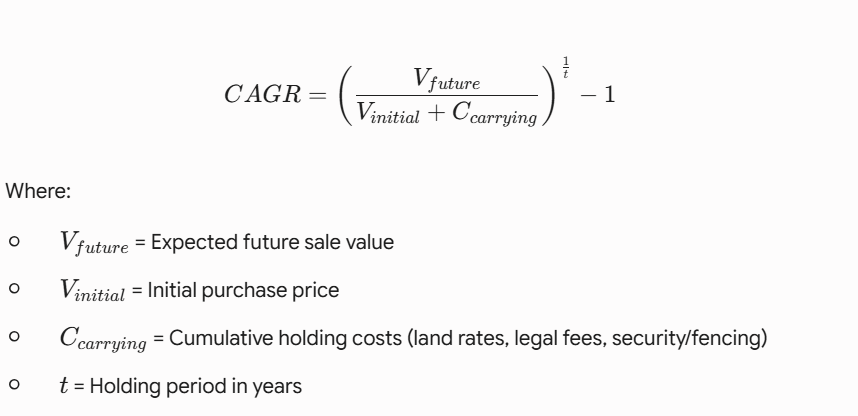
Where:
- $V_{future}$ = Expected future sale value
- $V_{initial}$ = Initial purchase price
- $C_{carrying}$ = Cumulative holding costs (land rates, legal fees, security/fencing)
- $t$ = Holding period in years
If a plot bought for KSh 2,000,000 incurs KSh 200,000 in carrying costs over 5 years and sells for KSh 4,500,000, the annualized return sits at approximately $15.4\%$. The core financial question is always whether that return beats alternative yield-generating assets after adjusting for risk and illiquidity.
The Due Diligence Framework: Evidence Over Speculation
The biggest pitfall in land banking is confusing cheap land with promising land. A cheap plot in an isolated area with no demographic momentum can remain cheap indefinitely. Strategic land selection requires a rigorous evaluation framework:
- Spatial Growth Corridors: Identify major transportation master plans, road expansions, and suburban commuter routes rather than buying in stagnant areas.
- Demographic Migration: Look for localized population growth, shifting school enrollment numbers, and commercial business cluster formations.
- Zoning & Land Use Policies: Verify permitted uses (residential, commercial, or light industrial) with local planning authorities to ensure long-term alignment.
- Title Integrity & Search Verification: Conduct official registry searches to confirm ownership, verify physical boundaries, and check for encumbrances or wayleaves.
- Carrying Cost Controls: Budget for property taxes/rates, perimeter fencing (to protect against adverse possession or encroachment), and routine maintenance.
Read Also : Your Land Has a Neighbourhood Life Cycle: From Farmland to a Thriving Urban Community
Strategizing the Wait
An empty plot may appear idle from the outside, but when backed by spatial research and demographic momentum, holding land is a deliberate allocation strategy. You are securing an option on an area’s future.
At Willstone Homes, we guide investors beyond simply finding affordable acreage. We focus on identifying growth corridors, evaluating surrounding infrastructure, and ensuring land purchases align with clear long-term wealth objectives—whether your goal is to construct later or hold for capital appreciation.
Sometimes the most value-accretive decision isn’t rushing to build today—it’s positioning your capital where the future neighborhood will build value for you.