
We see it all the time on roadside billboards and social media banners: “Prime 50×100 plots for sale in [emerging node], only KSh 600,000!”
To an eager investor or a family looking to build their dream home, this looks like the deal of a lifetime. Compared to a “serviced plot” in a gated estate that might cost KSh 1.5M to KSh 2.5M in the same general area, the raw plot seems like an obvious financial win.
But here is the reality that veteran developers know, and first-time buyers learn the hard way: Land is only cheap if you never intend to do anything with it.
When you buy a raw, unserviced piece of land, you aren’t just buying soil; you are inheriting a massive, multi-million-shilling infrastructure project where you are the sole contractor. Let’s break down the actual, verifiable costs of transforming a raw plot into a livable homestead in 2026, and why “cheap” land almost always costs double.
Read Also:What the KNBS 2023/24 Housing and Real Estate Survey Means for Kenyan Home Buyers and Investors
The True Cost Breakdown of Going It Alone
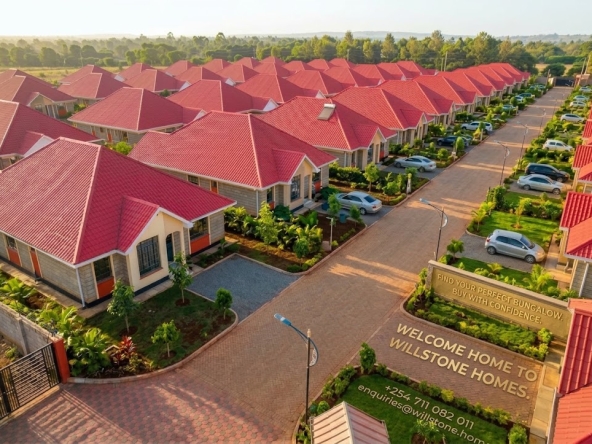
When you buy a plot inside a master-planned Willstone Homes gated community, your purchase price includes completed infrastructure. When you buy a standalone raw plot, you must pay out-of-pocket for every single utility.
Here is what the independent data says it will cost you to bridge that gap:
1. Water Security: The Borehole Gamble
You cannot build a house without water, and you certainly cannot live in one. If municipal lines aren’t nearby, you have to drill.
- The Reality: According to 2026 hydrogeological data across Nairobi, Kiambu, and Machakos counties, drilling a domestic borehole costs between KSh 3,800 and KSh 6,000 per meter, depending on whether you hit volcanic clay or igneous rock.
- The Math: An average stable water-strike requires a depth of 100 to 140 meters.
- Drilling & PVC Casing: ~KSh 550,000
- A basic 0.75HP submersible pump, control panels, and a 5,000L storage tank: ~KSh 150,000
- Statutory permits (Water Resources Authority – WRA): ~KSh 15,000
- Total Independent Cost: KSh 715,000+
2. Power Connection: The 600-Meter KPLC Trap
Many buyers assume that if they see a power line anywhere on the main road, they are safe.
- The Reality: Kenya Power (KPLC) standard subsidized domestic connection fees (around KSh 15,000 under the Last Mile project) only apply if your house is within 600 meters of an existing, un-maximised transformer.
- The Math: If your raw plot requires KPLC to clear paths, drop custom poles, and extend the low-voltage network just to reach your gate, the cost quickly skyrockets into a quotation of KSh 150,000 to KSh 500,000. If you opt to bypass KPLC entirely with a reliable hybrid solar system capable of running a modern household (3kW–5kW system with lithium storage), you are looking at a capital expense of KSh 350,000 to KSh 700,000.
- Total Independent Cost: KSh 250,000 to KSh 550,000
3. Civil Works: Roads & Drainage
Rain is the ultimate equalizer in real estate. A plot that looks beautiful in January can become an inaccessible swamp in May.
- The Reality: In a raw layout, there are no engineered roads. If you are the first to build, you must make the track leading to your plot passable so that heavy delivery trucks (carrying stones, sand, and cement) don’t get stuck.
- The Math: Grading a basic earth road and dropping a layer of murram just for your immediate access stretch, alongside basic blackwater/greywater drainage channel construction, will easily drain KSh 150,000 from your reserves.
- Total Independent Cost: KSh 150,000
4. Security & Fencing
On an open, unserviced field, your building materials will grow legs and walk away before the foundation is even poured.
- The Reality: You must secure the perimeter immediately.
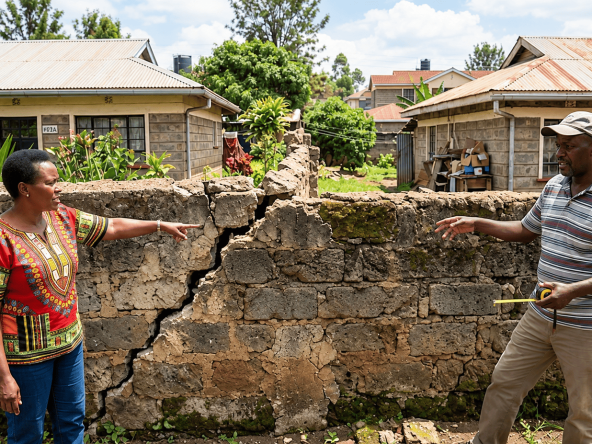
- The Math: Chain-link fencing with concrete poles for a standard 50×100 plot costs roughly KSh 120,000. If you build a permanent, secure natural stone perimeter wall with a gate—which is mandatory for long-term peace of mind—the cost scales to between KSh 350,000 and KSh 500,000.
- Total Independent Cost: KSh 350,000+
Read Also:The 60% Ceiling: Why So Many Kenyan Estates Stall into Permanence
The Financial Comparison: Raw vs. Serviced

Let’s look at the financial math side-by-side.
Imagine you purchase a raw plot for KSh 700,000 versus buying a fully serviced, secure plot within a gated community for KSh 1,800,000.
| Expense Item | The “Cheap” Raw Plot (KSh) | The Serviced Gated Plot (KSh) |
| Initial Land Purchase | 700,000 | 1,800,000 |
| Water (Borehole/Piping/Tanks) | 715,000 | Included (Value Share) |
| Power (KPLC Extension/Solar Setup) | 350,000 | Included (Value Share) |
| Access Roads & Drainage | 150,000 | Included (Value Share) |
| Perimeter Security Wall & Gate | 400,000 | Included (Estate Wall) |
| Approvals & Legal Compliance Friction | High Personal Effort | Streamlined by Developer |
| TOTAL INITIAL INVESTMENT | KSh 2,315,000 | KSh 1,800,000 |
The Verdict: You Saved Nothing
By choosing the “cheap” KSh 700,000 option, you actually spent KSh 2,315,000 just to get the land to a point where you can comfortably live on it. You spent KSh 515,000 more than the estate plot, and you still don’t have streetlights, 24/7 manned security, a kids’ play area, or an appreciating neighborhood of uniform, high-value homes.
⚠️ The Invisible Cost: Time and Mental Capital
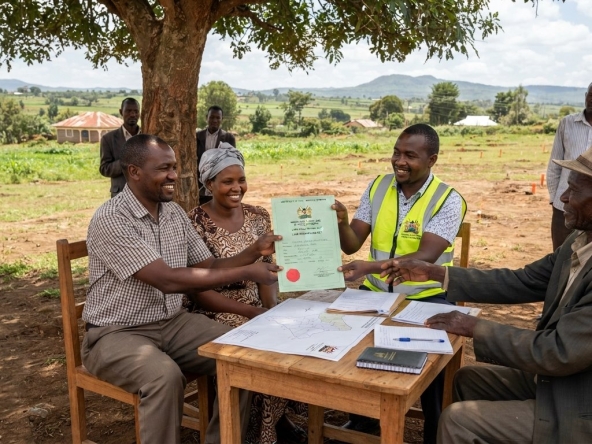
Beyond the monetary figures, think about the time inflation. Sourcing reputable borehole drillers, chasing KPLC for meters, dealing with local county planning offices for standalone approvals, and managing site theft can delay your construction timeline by 6 to 18 months. In a fluctuating economy, every month of delay means rising material costs (cement, steel, and labor).
Why Gated Communities Win the “Value Share” Math
Gated community developers like Willstone Homes don’t have access to cheaper cement or magic electricity. They win because of economies of scale.
When a developer drills one high-yield borehole, builds a central drainage system, tarmacs a main loop road, and installs a massive transformer, that multi-million shilling cost is divided across 50 or 100 plots. You are paying a tiny fraction of the infrastructure cost while enjoying 100% of the utility.
When you buy a serviced plot, you aren’t paying a premium for “luxury”—you are pooling your purchasing power with other smart investors to buy infrastructure at wholesale prices.
The Lesson: Before you buy a cheap plot, stop looking at the price of the dirt. Start calculating the cost of the infrastructure.