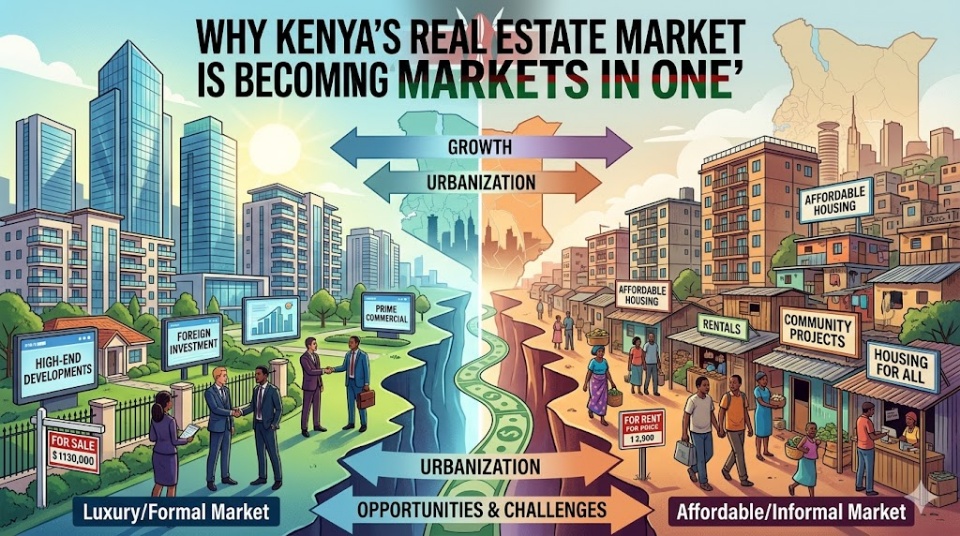
Kenya’s property sector is undergoing a quiet but significant transformation. The Kenya property market is no longer moving as a single, uniform system. Instead, it is increasingly splitting into two distinct segments—each driven by different demand forces, pricing behavior, and investment logic.
On one side is a stabilizing high-end urban market. On the other is a fast-expanding affordable and satellite-driven market. This divide is now shaping how investors approach real estate investment Kenya and redefining where value is being created.
A Market No Longer Moving in Sync

Recent performance data shows a widening gap between different property segments across the country. While overall property prices in Kenya are still growing modestly at around 7%–8% annually, the distribution of that growth is highly uneven.
Prime urban apartments in Nairobi have experienced price corrections in some zones, while standalone homes in select suburbs continue to appreciate. At the same time, satellite towns around Nairobi are showing mixed but active growth patterns depending on infrastructure and demand concentration.
This divergence is why analysts increasingly describe the Nairobi real estate market as “split”—with performance now defined more by location and property type than by general market momentum.
The High-End Urban Market: Stability Over Expansion
In established areas such as Westlands, Kilimani, Kileleshwa, and Karen, the market has entered a mature phase. Prices are no longer rising aggressively as they did in earlier cycles, but demand has not disappeared.
Instead, the market is becoming more selective. Buyers in these locations are largely driven by lifestyle, security, and long-term value retention rather than speculation. This has made premium property in Nairobi Kenya more of a stable asset class than a fast-growth opportunity.
However, oversupply in apartment-heavy zones has introduced pressure in certain segments. Some developments have recorded mild price declines, particularly where competition is high and absorption rates are slower. This shift is changing how investors evaluate houses for sale in Nairobi, with more emphasis now placed on quality, location, and rental stability.
The Satellite Town Boom: Where Growth Is Accelerating

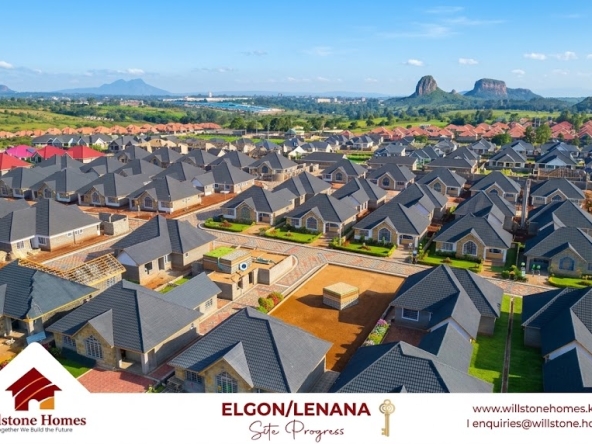
Outside the city core, a very different story is unfolding. Satellite towns such as Ruiru, Syokimau, Juja, Kitengela, and Ruaka are driving much of the current expansion in real estate opportunities in Kenya.
These areas are benefiting from improved infrastructure, including bypass roads and highway expansions that have significantly reduced commute times into Nairobi. As a result, they are becoming increasingly attractive to middle-income buyers seeking affordability and space.
In some of these locations, property values are still rising at healthy rates, while others are stabilizing after rapid earlier growth. This uneven performance reflects a market that is still adjusting but remains fundamentally strong for long-term property investment Kenya strategies.
Read Also:Homes for Sale in Nairobi | Houses for Sale in Kenya – Prices, Trends & Best Locations (2026 Guide)
Why the Market Has Split Into Two
The emergence of this “two-market system” is not accidental. It is the result of several structural forces acting simultaneously on the housing sector.
One major factor is oversupply in high-density urban areas. Over the past decade, apartment construction in Nairobi expanded rapidly, and in some locations supply has now outpaced immediate demand.
At the same time, infrastructure development has expanded the practical boundaries of Nairobi. Areas once considered peripheral are now viable residential zones, creating new growth corridors and shifting demand outward.
Income segmentation is also playing a major role. The market now serves two distinct buyer groups—high-income households focused on exclusivity and middle-income buyers prioritizing affordability and ownership. This dual demand structure is reshaping pricing dynamics across the Kenya property market.
What This Means for Investors
For investors in property for sale in Kenya, this structural shift changes the rules of engagement.
The high-end urban market now behaves more like a defensive asset class. Returns are driven less by capital appreciation and more by rental income stability and long-term holding value. It remains attractive but requires patience.
The satellite market, on the other hand, offers higher growth potential but comes with more variability. Timing, infrastructure proximity, and developer quality play a much larger role in outcomes. This is where many real estate developers in Kenya are currently concentrating new projects.
Understanding this divide is now essential for anyone making decisions in real estate in Nairobi Kenya, especially as market cycles become more location-specific.
A More Mature but Divided Property Landscape
Rather than signaling weakness, this division reflects a maturing housing sector. The market is becoming more segmented, more data-driven, and more sensitive to fundamentals than speculation.
For buyers looking to buy property in Kenya, this means strategy now matters more than ever. The same market can produce very different outcomes depending on where and what you invest in.
The Nairobi real estate market is no longer a single story. It is two parallel systems evolving side by side—each shaping Kenya’s housing future in different ways.
Final Perspective
Kenya’s real estate sector is entering a more complex but also more structured phase. The split between urban stability and satellite growth is not temporary—it is becoming the new normal.
For investors and homebuyers alike, success will depend on understanding this divide and positioning within the right segment of the market rather than treating the sector as a single unified opportunity.