
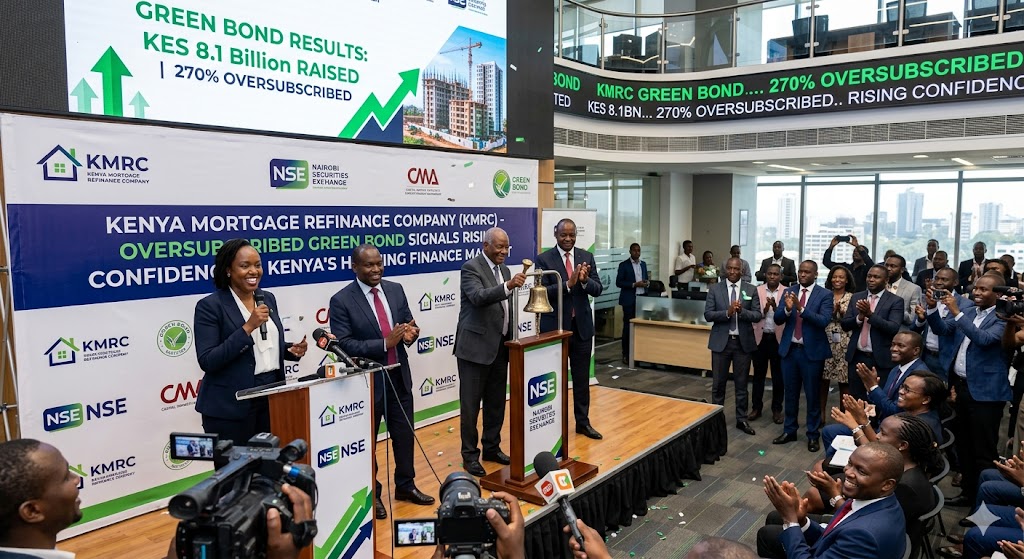
The strength of Kenya’s housing finance ecosystem—and by extension the broader Kenya property market—was reaffirmed after the Kenya Mortgage Refinance Company (KMRC) successfully raised KSh 3.0 billion through its second sustainability bond.
Investor appetite was notably strong, with total bids reaching KSh 9.38 billion, translating to a 312.8% oversubscription. This marks KMRC’s return to the capital markets for the first time since 2022, signaling renewed confidence in long-term property investment Kenya instruments.
Key Highlights of the Bond Issue

- The bond, structured as an eight-year amortising note, forms Tranche 2 of KMRC’s KSh 10.5 billion Medium-Term Note programme.
- It carries a 12.2% annual coupon, paid semi-annually.
- KMRC maintained discipline by accepting only the targeted KSh 3.0 billion, leaving KSh 6.38 billion in excess bids unallocated.
- The coupon rate is 30 basis points lower than Tranche 1, yet higher than Safaricom’s 10.4% sustainability bond issued in November 2025, which itself recorded a 177% oversubscription on a KSh 15.0 billion offer.
The bond has a Weighted Average Life of 5.10 years, with annual amortisation beginning in November 2026. Settlement is scheduled for 22 May 2026, with listing on the Nairobi Securities Exchange Fixed Income Securities Market on 25 May.
Driving Affordable Housing and Real Estate Growth
Proceeds from the bond will be directed toward refinancing eligible green and social home loans under KMRC’s Sustainable Finance Framework (March 2026). This initiative is further supported by concessional funding from the World Bank and the African Development Bank.
This financing model plays a critical role in expanding access to mortgages, directly impacting demand for houses for sale in Nairobi and other urban centers. By lowering borrowing costs for lenders, KMRC is helping unlock broader access to property in Nairobi Kenya and across the country.
Performance in Context: Comparing Tranches
While the 312.8% oversubscription is impressive, it trails the 480% recorded in February 2022 during Tranche 1, where KMRC raised KSh 1.4 billion against KSh 8.1 billion in bids at a 12.5% coupon.
The slightly lower subscription level in the current tranche can be partly attributed to:
- A larger offer size, and
- A reduced coupon rate, reflecting shifting market dynamics.
As of December 2025, KSh 936.7 million of Tranche 1 remained outstanding, with KSh 463.3 million already repaid through scheduled amortisations.
Improving Monetary Conditions Support Real Estate Financing
KMRC had postponed a planned 2024 bond issuance due to elevated interest rates that conflicted with its affordable housing mandate. However, the environment has since improved.
The Central Bank of Kenya has reduced its benchmark rate by 250 basis points to 8.75%, creating a more favorable environment for raising capital and supporting real estate investment Kenya.
Lower interest rates are particularly significant for:
- First-time buyers looking to buy property in Kenya
- Developers expanding supply within the Nairobi real estate market
- Financial institutions supporting mortgage uptake
KMRC’s Expanding Role in Kenya’s Real Estate Ecosystem
KMRC’s growing loan book reflects increasing activity in the housing sector. As of end-2025:
- The loan book stood at KSh 19.6 billion, up from KSh 11.9 billion the previous year
- Over 4,600 mortgages have been refinanced
- Total mortgage value reached approximately KSh 21.7 billion across 39 counties
This expansion is directly influencing real estate in Nairobi Kenya and other regions by improving liquidity and access to housing finance.
However, declining interest rates have also impacted earnings, with net interest income falling from KSh 2.2 billion to KSh 1.7 billion over the same period.
Read Also: Homes for Sale in Nairobi | Houses for Sale in Kenya – Prices, Trends & Best Locations (2026 Guide)
What This Means for Investors and Homebuyers

The strong demand for KMRC’s bond underscores a broader trend: growing investor confidence in Kenya’s housing sector and the long-term potential of real estate opportunities in Kenya.
For market participants, this translates into:
- Improved access to mortgage financing
- Increased supply of property for sale in Kenya
- Strengthened fundamentals within the Kenya property market
KMRC’s successful return to the capital markets is more than a funding milestone—it is a clear signal that Kenya’s housing finance model is gaining traction.
As liquidity improves and financing becomes more accessible, both investors and homebuyers stand to benefit from a more dynamic and inclusive Nairobi real estate market.