
Kenya’s real estate sector is undergoing a massive structural transformation, driven by an unprecedented influx of overseas capital. Data from the 2025 Household Remittance Survey—jointly conducted by the Central Bank of Kenya (CBK) and the Kenya National Bureau of Statistics (KNBS)—reveals that diaspora inflows have firmly transitioned from a family safety net into a formidable engine for wealth creation through property development.
Historically, the State Department for Diaspora Affairs estimated that up to 80% of remittances were swallowed by immediate consumption—such as food and medical bills. Today, that script has flipped. With Kenyans abroad sending home a staggering KSh 931.8 billion ($7.1 billion) annually, nearly seven out of ten remittance-receiving households now own multiple residential units.
The data paints a vivid picture of how overseas earnings are transforming the landscape, dividing investments between rural legacy homes and high-yield urban apartments.
Read Also: The 7.4% Suburb Standoff: Why Nairobi Landlords Are Holding Rent Steady Despite High Vacancies
The Scale of Diaspora Property Ownership
The sheer volume of real estate funded by the diaspora highlights a rapid transition toward permanent asset accumulation. According to the survey:
- 1 to 2 Units: 66.1 percent of remittance-receiving households (equivalent to 449,695 families) own one or two dwelling units.
- 3 to 4 Units: 17.8 percent (121,290 households) have built or acquired three to four units.
- 5+ Units: More than 108,000 households now manage a portfolio of five or more units, effectively entering the commercial rental market.
The Geopolitical Engine: The United States remains the primary driver of this real estate boom, accounting for 43.5 percent of total remittance inflows, followed closely by the United Kingdom, Germany, and Saudi Arabia.
The Great Divide: Rural Legacies vs. Urban Yield

Diaspora capital behaves very differently depending on where it lands. While rural investments focus on family stability and social prestige, urban investments are laser-focused on density and rental yields.
[Diaspora Inflows]
       │
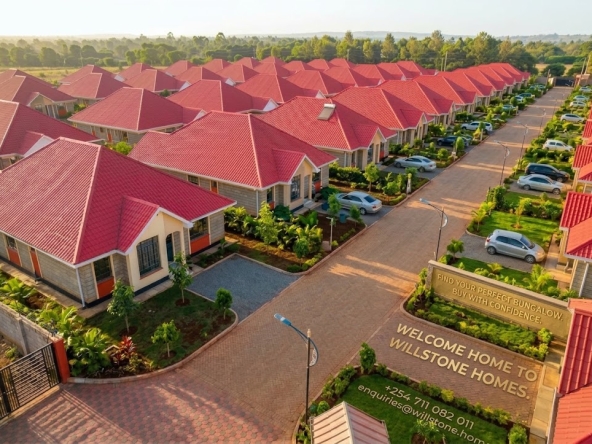
       ├─► Rural Areas (60.5%) ──► Bungalows ──► Family Wealth & Security
       │
       └─► Urban Areas (45.1%) ──► Flats/Apartments ──► High Rental Yields
1. Rural Kenya: The Bungalow Boom and Women Empowerment
Rural households account for the lion’s share of property ownership volume among remittance recipients. For families owning one to two units, 258,810 are located in rural areas compared to 190,885 in urban centers. For those owning three to four units, rural households represent more than three-quarters of the total.
- The Design Preference: Bungalow-style homes dominate rural landscapes, accounting for 60.5 percent of all homes built with diaspora money.
- Empowering Female-Headed Households: Notably, among female-headed households in rural Kenya, bungalows account for 67 percent of homes (compared to 57.8 percent for male-headed households). This highlights how targeted remittance corridors are enabling women to secure permanent land and modern housing.
2. Urban Kenya: Vertical Living
In towns and cities, the realities of high land costs and high demand for tenant housing have driven diaspora cash into vertical developments.
- The Rise of Flats: Apartments and flats are the dominant housing type, accounting for 45.1 percent of urban dwellings. Bungalows rank a distant second at 28.7 percent.
- The Investor Play: Rather than building single-family homes, diaspora buyers in urban pockets are investing in multi-story blocks to tap into monthly rental yields.
Upgrading the Fabric of Kenyan Housing
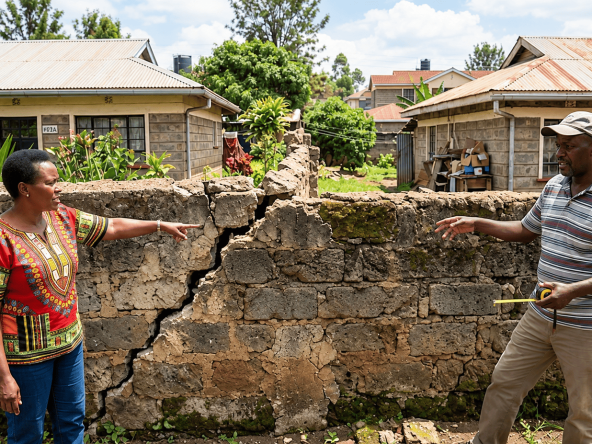
Beyond the quantity of units, diaspora billions are fundamentally upgrading the structural quality of Kenyan construction. Mud, thatch, and timber are rapidly giving way to premium, durable finishes.
Wall & Roof Integrity
- Modern Materials: Concrete and cement walls lead nationwide at 29.1 percent, closely trailed by stone walls built with lime or cement at 27.5 percent.
- The Rural Shift: While mud and cow-dung walls still hold a 17.8 percent share in deep rural areas, permanent concrete structures are right on their heels at 17.2 percent.
- Roofing Standards: Iron sheets remain the definitive choice across the country, covering 78.3 percent of all remittance-backed homes.
Premium Interior Finishes
The demand for high-end finishes is surging, particularly in urban areas where rentals must compete for affluent tenants.
- Ceramic tiles now cover 34 percent of floors in remittance-supported households.
- Concrete, cement, and terrazzo account for 33 percent, signaling a broad rejection of earth flooring in favor of sanitized, long-lasting surfaces.
The 2026 Market Outlook: Satellite Towns & PropTech

As we move through 2026, the intersection of diaspora capital and real estate is evolving. Industry insiders point to two distinct trends shaping the immediate future:
- The Flight to Satellite Towns: With land prices in Nairobi’s central business districts reaching saturation, diaspora buyers are heavily targeting satellite nodes like Ruiru, Joska, Kangundo Road, and Juja. These locations offer the sprawling acreage required to build standalone bungalows while maintaining commuting proximity to the city.
- The PropTech Verification Shield: Historically, the greatest barrier to diaspora investment was “kinship fraud”—where relatives diverted construction funds for personal use. The explosive adoption of real estate tech platforms offering remote project management, milestone-based escrow accounts, and live drone feeds has restored investor confidence, directly unlocking the surge in multi-unit properties seen in the survey.
Diaspora capital is no longer just keeping the lights on for families back home; it is permanently shifting the wealth index of the country, one concrete slab at a time.
Read Also: From Smart to Safe: How Predictive AI Security is Rewriting Nairobi House Prices