

For decades, Kenyan homebuyers seeking commercial bank mortgages faced unpredictable interest rate adjustments. Banks frequently cited shifts in the Central Bank Rate (CBR) or internal cost-of-funds metrics to justify sudden spikes in monthly mortgage repayments.
The Central Bank of Kenya (CBK) completed a major policy shift under its Risk-Based Credit Pricing Model (RBCPM), mandating that all commercial banks transition variable-rate Kenyan Shilling loans to a unified benchmark: KESONIA (Kenya Shilling Overnight Interbank Average).
Understanding how KESONIA works—and how it directly impacts long-term debt servicing—is critical for middle-class buyers evaluating whether to finance a home through a 15-year bank mortgage or a developer-funded flexible payment plan.
Read Also: Lifestyle Over Location: Why Nairobi’s Real Estate Providers Must Adapt to the New Kenyan Homebuyer
1. What is KESONIA?
KESONIA stands for the Kenya Shilling Overnight Interbank Average. Published daily by the CBK, it represents the volume-weighted average interest rate at which commercial banks lend unsecured overnight funds to one another.
+-----------------------------------------------------------------------------------+
|                        NEW VARIABLE LOAN PRICING FORMULA                          |
|                                                                                   |
|  Effective Bank Interest Rate = KESONIA Benchmark Rate + Bank Risk Premium (K)    |
|                                 (CBK Daily Overnight)    (Customer Risk Profile)  |
+-----------------------------------------------------------------------------------+
Why CBK Introduced KESONIA
- Elimination of Arbitrary Base Rates: Previously, commercial banks calculated interest using proprietary base rates that were difficult for borrowers to audit. KESONIA provides an objective, transaction-based reference rate aligned with global standards like SOFR (US) and SONIA (UK).
- Transparency: Borrowers can verify the daily KESONIA rate directly on the Central Bank of Kenya website.
- Dynamic Adjustments: Variable mortgage rates now adjust predictably as the interbank market rate moves, rather than through sudden bank-specific notices.
2. The Hidden Math Behind Bank Mortgage Rates
While KESONIA standardizes the base reference rate, it does not cap the total interest rate a bank can charge.
Your effective commercial mortgage rate is calculated as:
$$\text{Effective Interest Rate} = \text{KESONIA} + K$$
Where $K$ is the Bank Risk Premium—a custom margin added by the lender based on your credit score, income stability, and loan duration.
  Commercial Bank Mortgage Rate Breakdown
  ---------------------------------------
  KESONIA Base Benchmark:     ~8.75%
  + Bank Margin / Spread (K): ~6.75% to 8.50%
  ---------------------------------------
  Total Variable Rate:       15.50% to 17.25% APR
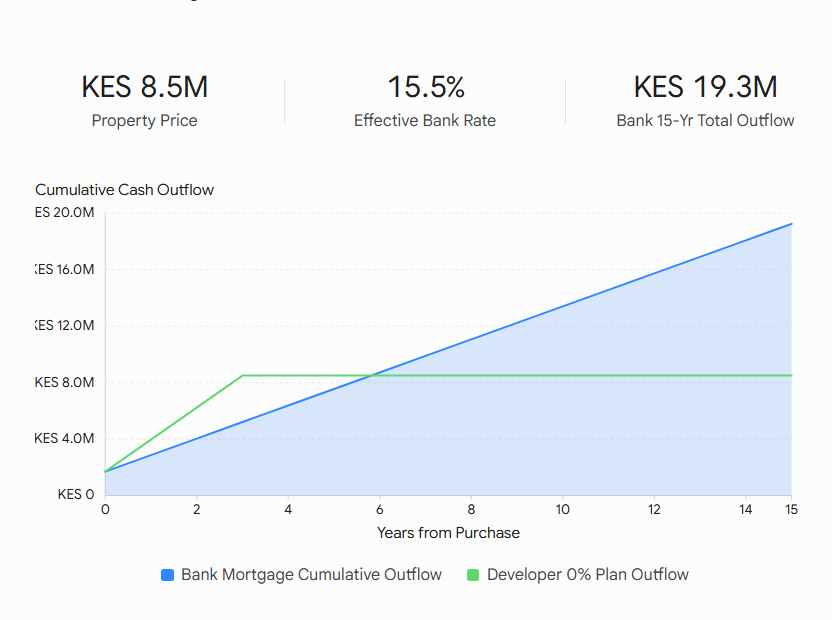
Even with KESONIA providing transparency at the base level, the bank margin ($K$) keeps commercial mortgages priced between 15% and 17%+ APR. On a 15-year variable mortgage, compound interest causes total interest repayments to far exceed the original purchase price of the home.
Read Also: The High Cost of Moving In: Why Kenyan Landlords Demand Steep Deposits—and What the Law Says
3. Financial Simulation: 15-Year Bank Mortgage vs. 3-Year Developer Plan
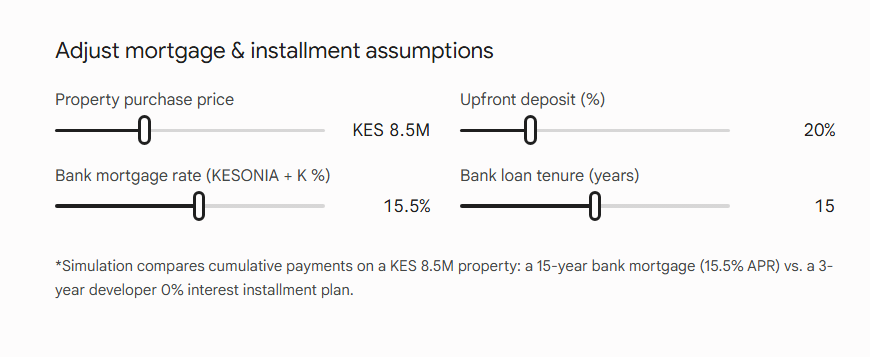
To understand the long-term cash flow impact, compare a 15-Year Bank Mortgage at 15.5% variable interest against a 3-Year Developer 0% Interest Installment Plan for a KES 8,500,000 bungalow or maisonette.
4. Comparing Financing Options: Commercial Bank vs. Developer Off-Plan
| Feature / Dimension | Commercial Bank Mortgage (KESONIA-Linked) | Developer Flexible Payment Plan (e.g., Willstone Homes) |
| Pricing Framework | Variable: KESONIA + Bank Margin ($K$) | Fixed: Total purchase price agreed upfront in contract. |
| Effective Interest Rate | 15.0% – 17.5% APR | 0% Interest over construction period (12–36 months). |
| Total Property Outflow | 220% – 250% of house value over 15 years due to interest compound. | 100% of agreed purchase price. |
| Down Payment Requirement | 10% – 20% plus bank processing, appraisal, & legal fees. | Structured deposit (e.g., 20% – 30%), balance spread across construction milestones. |
| Interest Rate Volatility | High: Monthly repayments fluctuate whenever interbank liquidity tightens. | Zero: Monthly or quarterly installments remain completely fixed. |
| Loan Qualification | Strict debt-to-income (DTI) caps, formal employment audits, legal processing delays. | Flexible buyer profiling based on income cash flow & milestone capability. |
5. Strategic Takeaways for Kenyan Homebuyers in 2026
- Calculate the True Total Cost of Credit (TCC): When reviewing a bank mortgage offer under KESONIA, look beyond the base benchmark rate. Demand a full breakdown of the bank margin ($K$), facility negotiation fees, legal conveyancing, valuation, and mandatory insurance costs.
- Leverage Off-Plan Developer Financing for Maximum Savings: If you have stable monthly cash flow, paying off a home over 12 to 36 months during construction eliminates interest payments entirely—saving millions of shillings compared to a bank loan.
- Consider Refinancing via KMRC Facilities: If you require long-term debt financing, ask whether your lender offers subsidized Kenya Mortgage Refinance Company (KMRC) loans, which provide single-digit fixed rates (typically 9.5%–10.5%) for homes priced under KES 10M, avoiding high commercial KESONIA spreads.
Read Also: Protecting Your Peace of Mind: A Homeowner’s Guide to Navigating El Niño